The 2026 State Legislative Session by the Numbers


The second regular session of the 75th General Assembly wrapped up in mid-May. This was the last regular session under Jared Polis's tenure as governor. As others have reported, the 2026 regular session was conducted under the cloud of the budget shortfall which constrained much of what legislators would have liked to do in the session.
A note about the data
The data from this post is drawn largely from LegiScan which compiles and formats state legislative data in a way that facilitates quantitative analysis. They provide data on legislative history, sponsorship and roll call votes that was especially useful for the analysis in this post. In the analysis of the page lengths of each bill, I relied on the links to each bill included in the LegiScan data and extracted the number of pages in each pdf file for the latest versions of the bills hosted on the website. The data considered in this post was last updated May 22, 2026.
Some of the numbers
During the course of the session, legislators cast a total of 117,250 recorded votes on the various items of business it considered (both floor votes and committee votes). Overall, legislators considered 714 bills, of these 288 (about 40%) passed both chambers and were sent to the governor. As of May 27, 162 bills (a little more than 20% of all bills) were signed by Polis.
If you were to print out the bills considered in this session, the resulting volumes would fill more than 6,500 pages. The page count of the bills actually signed by the governor (so far) comes to 1,517 pages (which, for context, is a little longer than the collected works of Shakespeare).
The median member of the legislature cast 1,186 recorded votes. Representative Yara Zokaie (a Democrat representing house district 52) cast the most (recorded) votes of any member with 1,707 votes. This is nearly a thousand more votes than the member with the fewest recorded votes (Robert Rodriguez a Democrat representing senate district 32 who cast 774 recorded votes – not counting the abbreviated term of Dafna Jenet who resigned from the legislature in February).
Legislative effectiveness
Political scientists who study lawmaking have developed the concept of "legislative effectiveness" to try to quantify the extent to which individual legislators vary in the degree to which they can get their proposals through the legislative system. The measures that are used in the academic literature are a little too involved for the purposes of this post, but in the same spirit, I constructed a similar measure with what was readily available.
In broad terms, my measure is designed to assign more credit for sponsoring longer bills, for supporting bills that ultimately succeed, and for participating in close committee votes where individual votes matter more. The measure is constructed in the following manner:
- The value of each bill is equal to its length in pages.
- The primary sponsor receives 10% of the value.
- The remaining sponsors split 10% of the value.
- Each legislator who voted on the winning side of a vote associated with the bill (either in committee or on the floor), splits 80% of the remaining value.
For example, if a particular bill was 35 pages long with 6 sponsors, points would be allocated as follows:
- The primary sponsor would get 3.5 points (plus any points they might receive from their votes on the bill).
- The remaining 5 sponsors would split the 3.5 points 5 ways (0.7 points each).
- If there were 4 votes on the bill, each of the votes would be 7 points (which would be allocated among those who voted on the winning side of each vote)
- Vote 1 (committee vote, 7-3): 1 point for each 'yea' vote (7 points divided by the 7 supporting votes)
- Vote 2 (committee vote, 9-1): 0.8 points for each 'yea' vote (7 points divided by the 9 supporting votes)
- Vote 3 (House floor vote, 50-15): 0.1 points for each 'yea' vote
- Vote 4 (Senate floor vote, 30-5): 0.2 points for each 'yea' vote
There are obvious limitations to this method. Bill length is a very crude proxy for significance. The way the points are allocated surely do not completely capture the process, and there are many parts of what goes into lawmaking that are not observed at all in the data. These scores also reflect institutional position. Legislators serving in leadership or on key committees naturally have greater opportunities to shape major legislation.
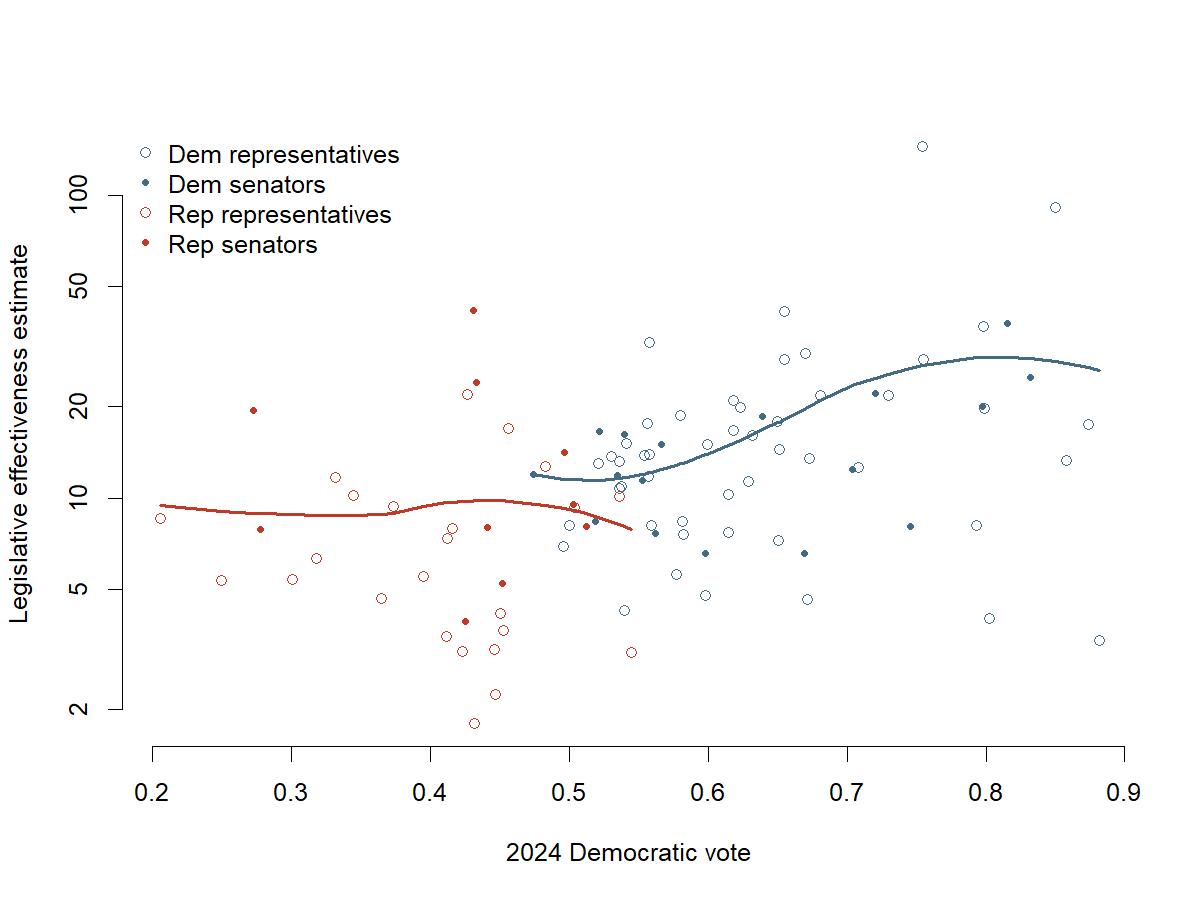
The resulting score for each legislator can be interpreted as the number of pages of successful legislation for which they were responsible (again, in a very rough sense). For the most recent legislative session, Rep. Emily Sirota (D-9) had the highest legislative effectiveness score (by a wide margin). By my crude accounting, she is credited with nearly 10% of the total output of the legislature (145.5 of 1517 total pages of legislation). Her positions on the critical Appropriations and Joint Budget committees ensured that she was a key player in some of the most important (and lengthy) bills of the session.
Members in the majority will be significantly advantaged when it comes to legislative effectiveness measured in this way because of the agenda setting power that the majority wields in nearly all legislatures. For this session, the median Republican representative in the lower chamber is credited with less than half the legislative effectiveness as the median Democrat (6 pages for the typical Republican, 13.5 for the typical Democrat). The gap is somewhat smaller in the Senate (12 pages for the typical Democrat, 9 pages for the typical Republican). The most effective Republican in this session was Sen. Lisa Frizell (R-22) who is credited with 41.5 pages of legislation (more than four times the output of her typical copartisans in the Senate and substantially more than the typical Democrat in her chamber).
Legislative effectiveness is modestly related to district partisanship (at least among Democrats). Democrats representing more solidly Democratic districts were on average more productive during the session than their colleagues representing more closely divided districts. Among Republicans, there is essentially no relationship between district partisanship and my measure of legislative effectiveness.
Legislative effectiveness among Colorado legislators, 2026 regular session