Preparing for a long, fiery summer
What does Colorado's historically dry winter portend for fire season?


The winter of 2025/2026 was historically warm and dry. Consequently, the snowpack buildup in the Rocky Mountains was at a 40-year low. Colorado depends in large part on water that comes from snowmelt, and years with lower levels of snowpack tend to correspond with more significant fires.
A note about the analysis in this post
The data in this post comes from public resources on snowpack and fire magnitudes. I am not a climatologist nor do I have expertise in fire management or related disciplines. I come at this very much as an amateur and cognizant of the possibility of making silly errors. Consequently, I will try to stick as close to the data as I can. Caveat lector.
A historically snowless winter
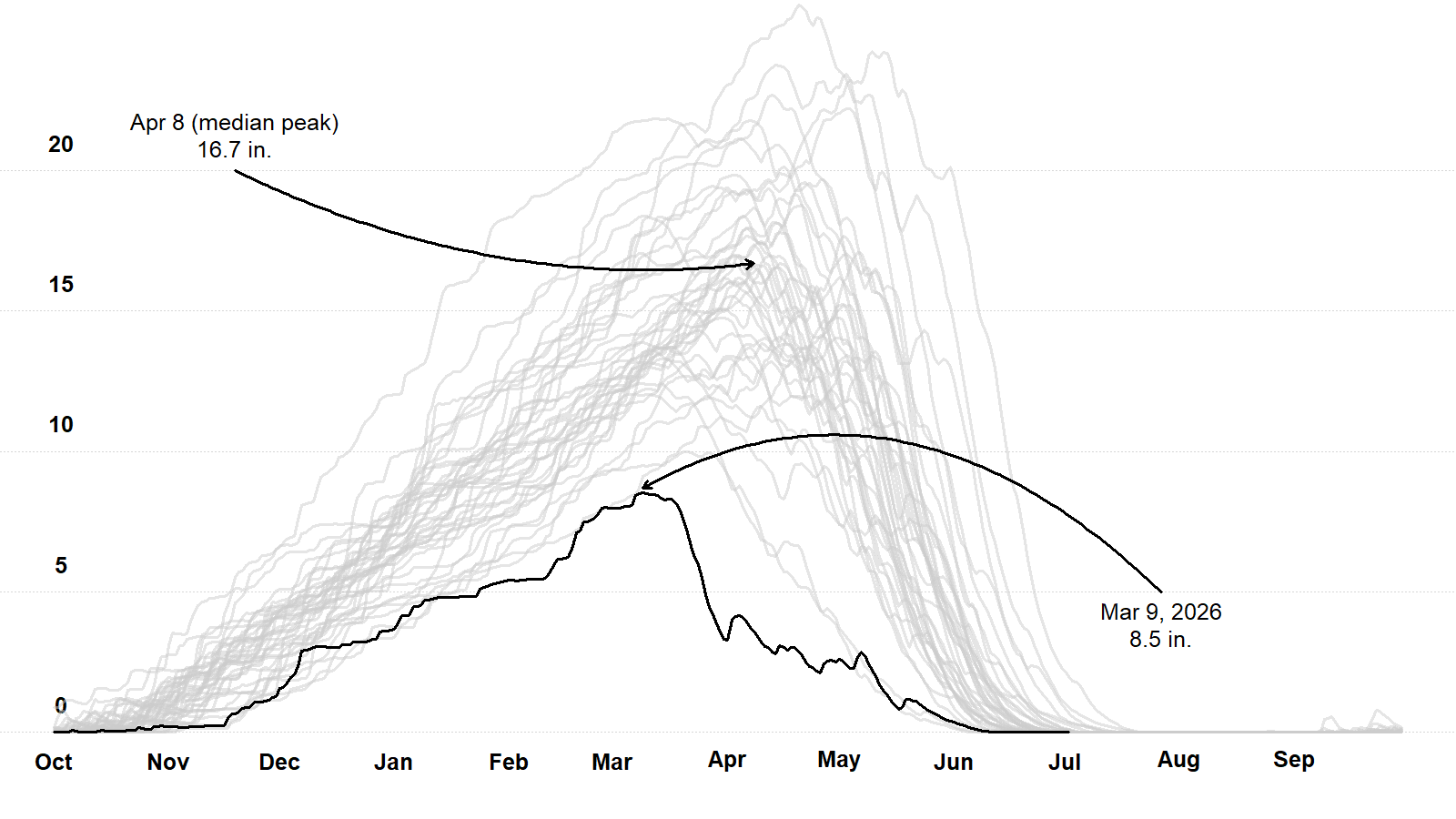
The graphic below shows the "snow water equivalent" (the amount of water stored in snowfall) for the past forty years in Colorado. Each line shows how snow accumulates and melts over the course of the year, and 2026 is shown in a heavier line. Over the past four decades, snowpack has typically peaked in early April at over 16 inches of water equivalent. This year, the peak hit in early March – a full month earlier than what has been typical – at just over half of its typical value.
Snow water equivalent in Colorado, 1987-2026
The association between peak snowpack and fire season
As I write this, the Aspen Acres fire has passed more than 66,000 acres burned, making it the 9th largest recorded fire in Colorado's history. Wildfires in Colorado have become more intense as a result of climate change and a host of other factors. Many of the years with the most significant fires have also been years where Colorado had the least snowpack.
Peak snowpack and fire intensity in Colorado, 1995-2025
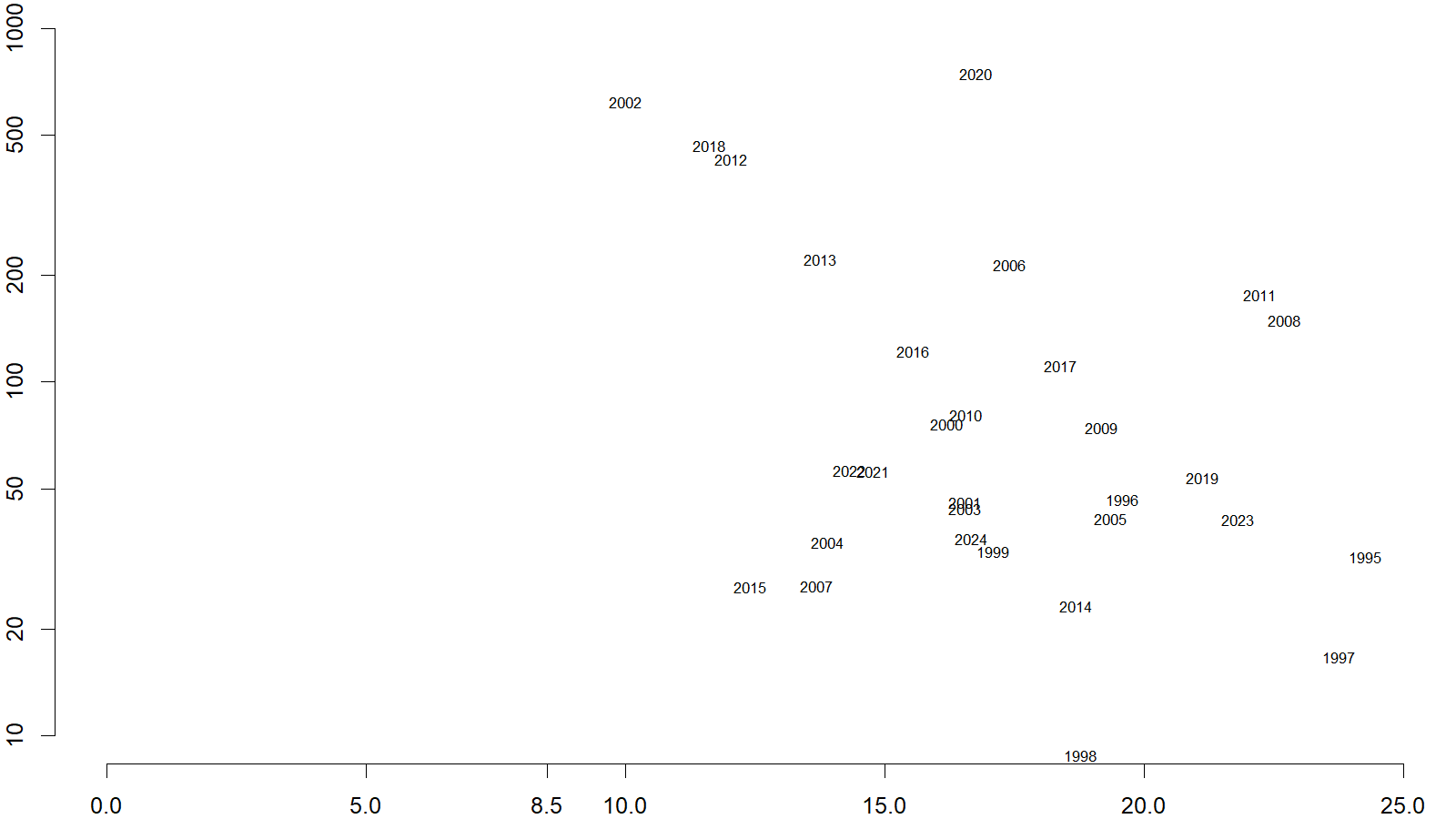
Prior to this year, 2002 set the record for lowest snowpack in the past thirty years with just over 10 inches. The 2002 fire season was also the second worst on record in terms of total acres burned. The table below shows the rankings of each year in terms of least snowpack and the rankings of the largest fires. The 2002, 2018, and 2012 seasons had the lowest levels of snowpack on record and claimed ranks 2 through 4 in terms of fire intensity.
| Year | Snowpack Rank (Least → Greatest) |
Fire Rank |
|---|---|---|
| 2002 | 1 | 2 |
| 2018 | 2 | 3 |
| 2012 | 3 | 4 |
| 2015 | 4 | 28 |
| 2007 | 5 | 27 |
| … | ||
| 2020 | 17 | 1 |
The relationship isn't perfect, however. For example, 2015 and 2007 ranked 4th and 5th in terms of least amount of snow but ranked near the bottom of the list in terms of fire intensity. The worst year for fires in the past three decades was 2020, but 2020 falls in about the middle of the pack for snowfall.
Some concluding thoughts
Extreme weather events that have become more common as a result of climate change are making life increasingly difficult for Coloradans. Obviously the direct impact of drought, fires, hailstorms, tornadoes and the entire cast of climate change terribles is devastating enough. The increasing likelihood of these disasters has made it more difficult to insure properties in Colorado, and it is possible that they might make some parts of the state effectively uninhabitable.
Regardless of one's position on anthropogenic climate change (and I hope it is obvious from what I've written that I am firmly in the camp of climate change is real and has been caused by human actions), the increasing frequency and intensity of natural disasters in Colorado and around the world is impossible to deny.
One important social science insight is that there are no "natural disasters." The impact of natural phenomena on human societies is almost without fail the result of human decisions. This is not to say that drought, fires, hail and tornadoes are directly caused by some human decision (although, again, human decisions certainly aren't helping the matter), but the impact of these events and what elevates them to the level of disasters is the result of human decisions. Who bears the highest cost and how we recover from these events are fundamentally human decisions.