Colorado's 2026 primary
Some observations about the June 30 primary elections in Colorado


The results of Tuesday's primary elections are somewhat confounding for those searching for a tidy story to sum up the results. On the one hand, Phil Weiser's commanding defeat of Michael Bennet for the Democratic nomination and Melat Kiros's upset victory in CD01 are points in favor of the "insurgent progressive" narrative.
Undercutting that story somewhat is Hickenlooper's relatively easy race against his progressive challenger, Julie Gonzalez. Also, despite anemic fundraising numbers, Barb Kirkmeyer's relatively more establishment campaign looks as if it may narrowly eek out a win over Victor Marx's and Scott Bottoms's decidedly more anti-establishment candidacies.
On balance, "insurgent progressive" narrative seems to more closely reflect reality in Colorado, but it is always a mistake to take these simplifications too far.
Important note: This post was composed and published prior to the final election results being certified. The observations herein are based on preliminary data (though in most cases 85-90% of the ballots had be counted).
Overall turnout
Colorado makes participating in elections extraordinarily easy. All registered voters are sent ballots which they can return by mail or drop into drop boxes located throughout the state. However, primary elections can be confusing to voters and they are typically lower turnout affairs. These elections typically garner lower levels of spending and advertising compared to general election contests, and many voters do not know much about the candidates competing. Under these conditions – and crucially in the absence of party cues to help voters decide which candidate to support – people tend to be less invested in their outcomes.
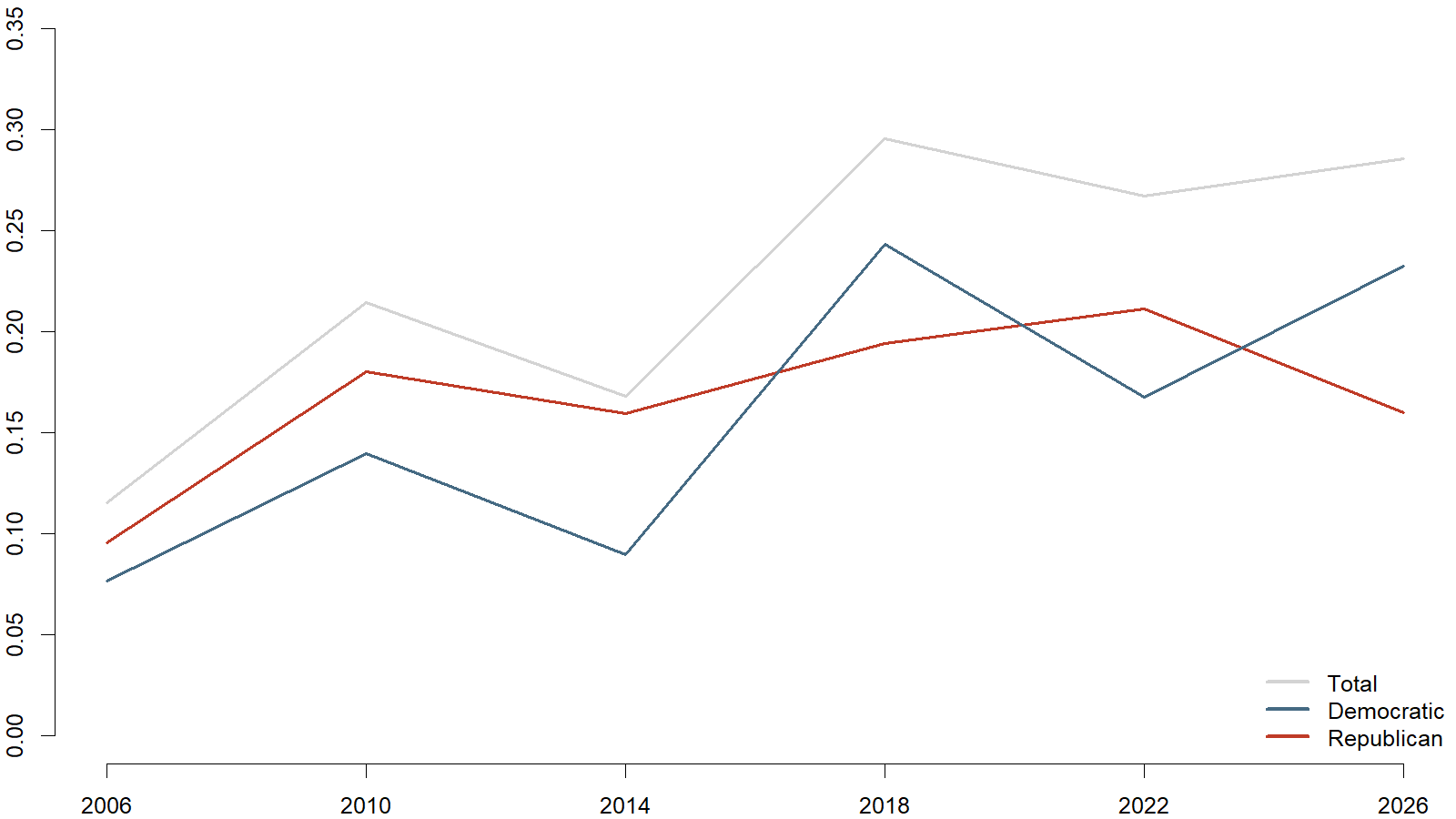
The graphic below shows the overall turnout rates for the past two decades of gubernatorial primary elections in Colorado. Turnout in the 2026 election was nearly as high as the last time there was an open primary on the Democratic side (2018). Similar to 2018, Democratic turnout outpaced Republican turnout in 2026.
Turnout in gubernatorial primaries in Colorado, 2006-2026
District 1: Kiros over DeGette
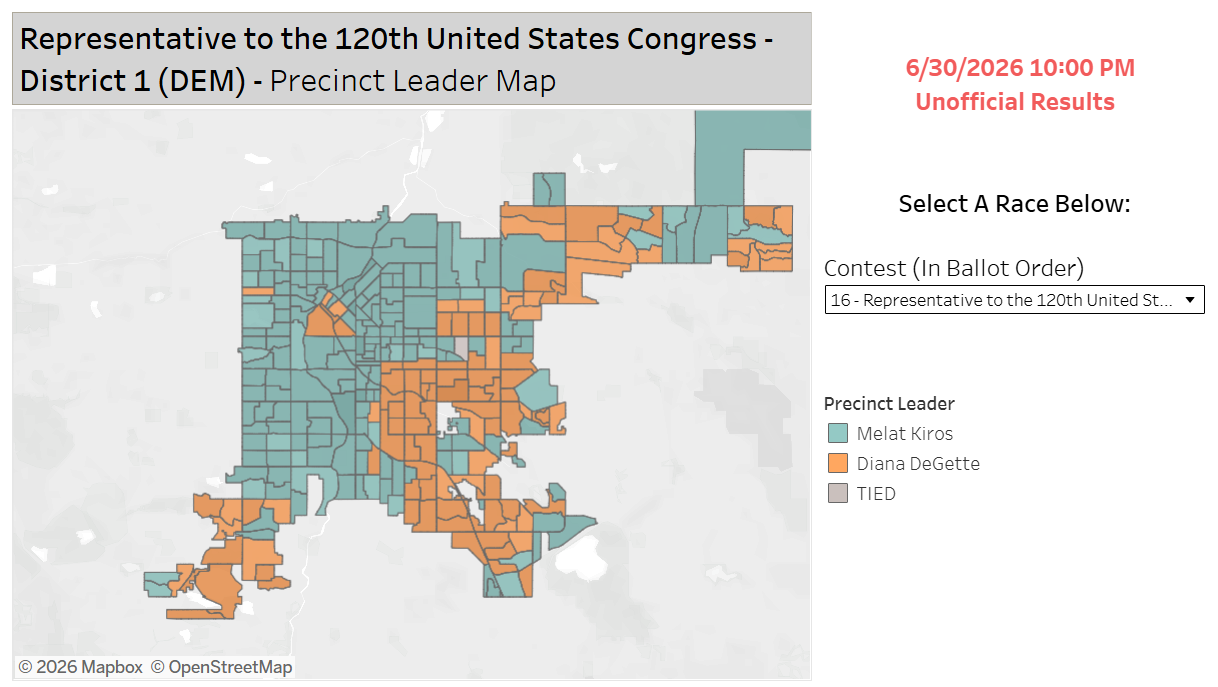
Melat Kiros's upset victory in Colorado's bluest district is a significant victory for the DSA as they demonstrate they can put up victories outside of coastal cities. The results within Denver show a significant geographic divide within the state's capital city. Kiros's generally performed better on the western side of the city while DeGette received most of her support from the more affluent and Whiter eastern neighborhoods.
The geography of Kiros's win in CD01
District 8: Rutinel over Bird
Manny Rutinel's resounding victory in the 8th district (61% to 34% for Bird) is perhaps another sign that Democrats are looking for fighters as we move into the sunset of Donald Trump's Republican Party. Rutinel will go on to face incumbent Republican Gabe Evans in the November election, and given national conditions, he has a very good chance of winning Colorado's most closely divided district.
Democrats in the state legislature
Several Democratic incumbents faced primary challenges from their left in Tuesday's elections. Iris Halpern (HD06) and Gabriel Cervantes (HD31) were both leading with about 90% of the vote counted in their districts. These candidates were challenging Democratic incumbents from the left.
Two more progressive incumbents (Kenny Nguyen, HD33 and Jamie Jackson, HD41) easily won reelection bids from candidates that were positioning themselves as more moderate.
There was at least one counterexample in Chauncy Johnson's unsuccessful progressive challenge to incumbent Regina English in HD17.
Whither the Republicans?
The fact that Marx did not immediately run away with the nomination (which has still not been called as of this writing) despite his commanding lead in fundraising may be an indicator that rank-and-file Republicans in the state are asking for some kind of return to normalcy. The Colorado Republican Party remains in considerable disarray, but perhaps their support for the relatively 'normal' candidate among the choices on offer will help to settle internal debates about the direction of their party.