$1 Billion on Ping Pong: What Colorado’s Sports Betting Data Reveals
Coloradans have wagered more than a billion dollars on table tennis since the legalization of online sports betting, but that is only a small part of the story.


Sports betting has become an enormous industry in the United States. Since restrictions on sports betting were lifted in 2018 nationally, overall spending on online sports betting has eclipsed almost every other form of entertainment. Colorado legalized online sports betting in 2020, and the industry has grown enormously since that time. In the 2026 legislative session, the legislature placed some additional limits on online sports betting intended to curb some of the most dangerous behaviors with respect to these betting apps. Those limits have recently been implemented, and it will be interesting going forward to track their impact (if at all) on the gambling economy. In this post, I'll review some of the trends in sports betting over the past six years.
About the data used in this post
The Colorado Department of Revenue publishes monthly reports (released on about two-month delay) that show the total amounts wagered and paid out each month broken out by in-person and online modes as well as the ten most popular sports for gambling that month. The report also includes the gross revenue (e.g. the difference between the wagers and the payouts) as well as the net sports betting revenue (the total revenue after accounting for eligible write-offs) and the tax paid by the betting companies. In addition to the revenue reports, I've also pulled some historical search engine data to get a sense for how interested Coloradans were in their professional sports teams (the Nuggets, the Broncos, the Avalanche and the Rockies) during this period.
Who are the online gamblers?
Unfortunately, there is no reliable source of data that I was able to access about the specific dynamics of online gambling among Coloradans. There are a few high-quality, national surveys. For example, Pew Research Center recently published the results of a national survey last year which found that one-in-ten American adults used a betting app to bet money on sports (up from 6% in 2022). The survey found that younger people and men were the demographic groupings most likely to gamble (either online or in person). I don't think there is much reason to believe the demographic patterns in Colorado are much different.
How much are Coloradans gambling online?
The figure below shows the cumulative total amounts wagered by month over the course of the year. As of June 2026 (the latest report available), the total amount wagered among Coloradans is only slightly higher than it had been by this point in 2025. In 2025, Coloradans wagered more than $6.3 billion online in sports bets.
Cumulative amounts wagered online on sports among Coloradans each year, 2021-2026
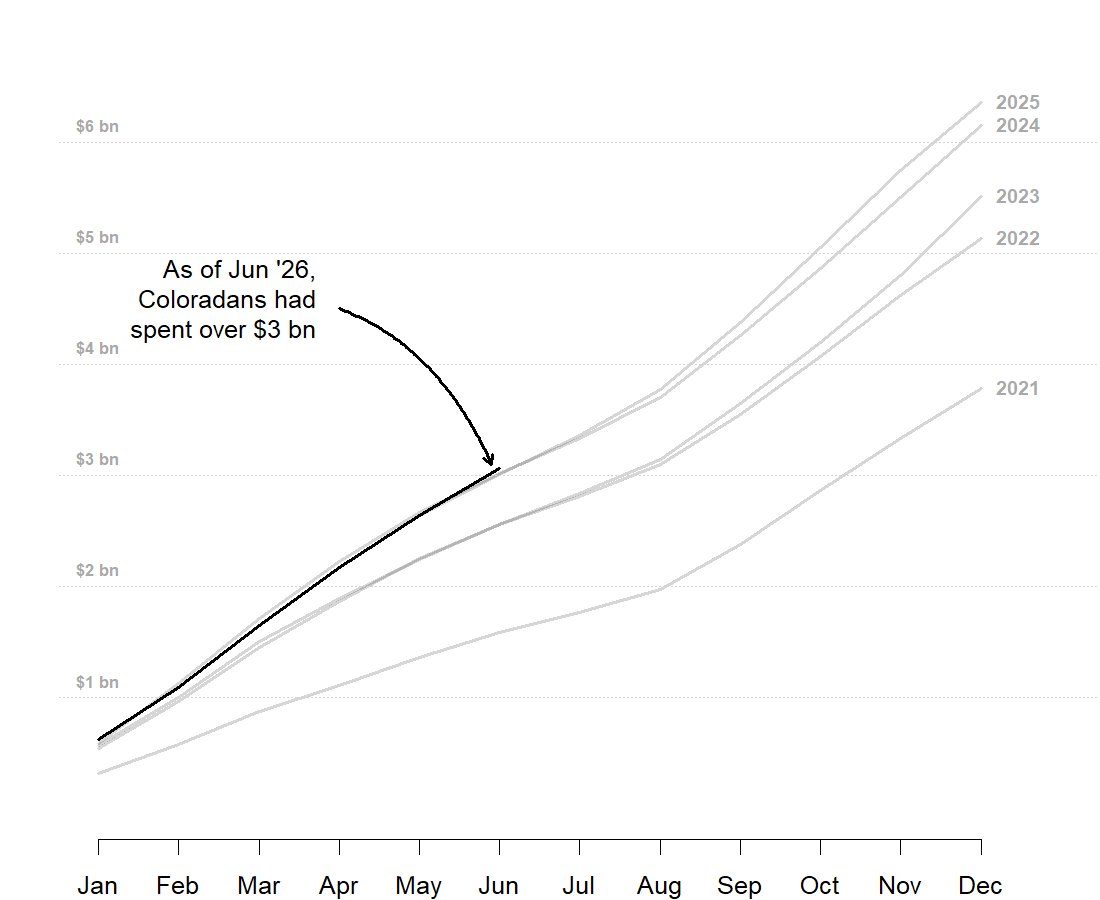
The figure above also shows the dramatic growth of the online gambling industry in Colorado. In 2021 (the first full year in which it was legal), Coloradans wagered somewhat less than $4 billion online. That grew to over $5 billion in 2022, about $5.5 billion in 2023, just over $6 billion in 2024 and $6.3 billion in 2025. The pace of the spending on online sports betting picks up in the fall months with football and basketball seasons, but overall wagers are spread pretty regularly throughout the year.
What are Coloradans betting on?
One of the central marketing pitches made by the online betting companies is that having some money on the line makes the sports viewing more exciting for fans. Colorado is home to four professional sports teams, and while we can't know from this data which specific teams people are wagering on, there is evidence that betting behavior in Colorado tracks other measures of interest in our local teams.
Breakdown of online sports betting in Colorado, 2021-2026
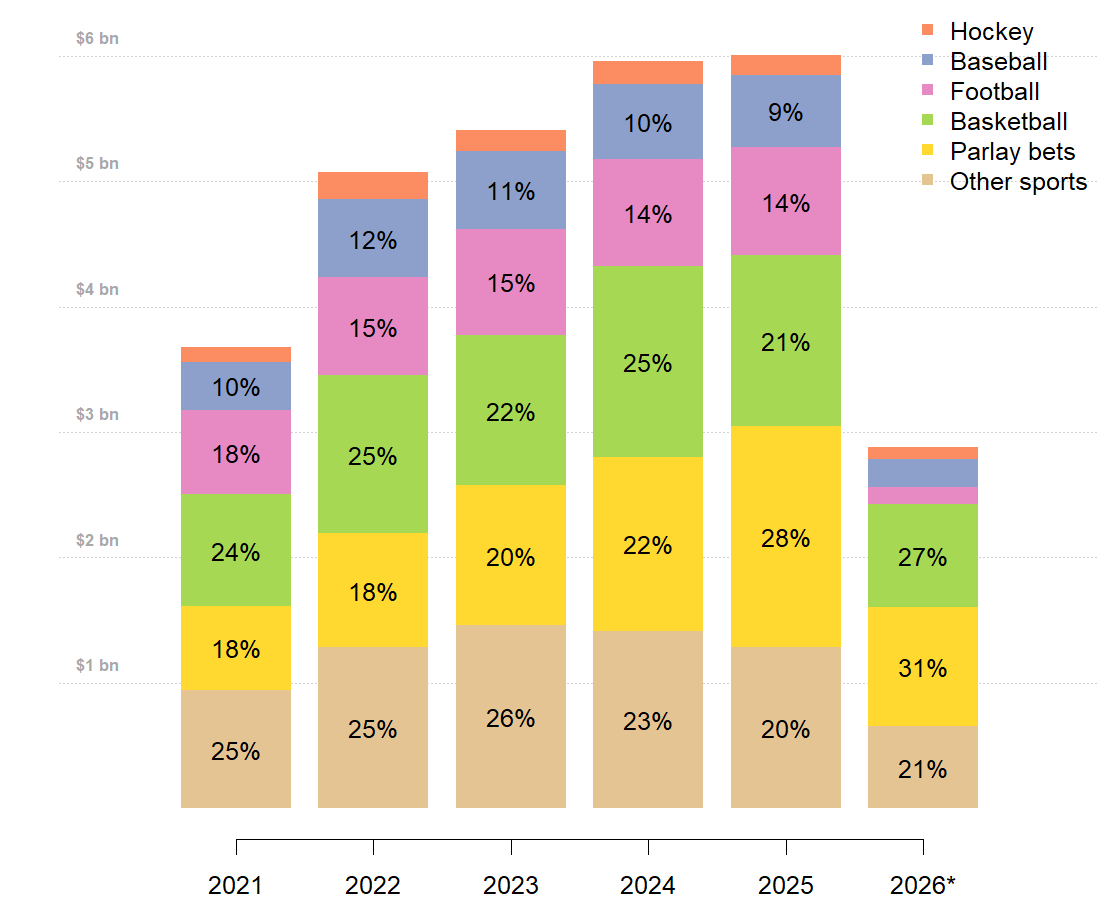
One notable trend in the composition of bets over time is the growing share of total wagers that are being made on "parlay" bets. In gambling parlance, a parlay is a bet that combines multiple wagers (e.g. a bet the Nuggets will win the game and that a particular player will score a certain number of points). These bets have higher potential returns (and consequently are much less likely to pay out). In 2021, parlays made up only 18% of all wagers. As of 2026, they made up 31% of all bets.
The curious case of table tennis
One oddity of this data is the persistent (and growing) popularity of wagers on table tennis. Table tennis makes the top 10 list of the most popular sports Coloradans are betting on in every month since online sports gambling was legalized in 2020. In the earliest part of the time series (mid-2020), Coloradans were wagering an average of $10 million each month on table tennis games (during the beginning of the pandemic, table tennis was one of the only sports available). That total dropped regularly through 2020 and 2021 to its low point of just over $5 million per month at the end of 2022. Since that time, the amount wagered on table tennis has risen substantially. In 2025 and so through June of 2026, Coloradans have wagered about $30 million each month on the sport.
As of the latest data available, Coloradans have wagered a combined $1.05 billion on table tennis games.
Monthly online wagers on table tennis games in Colorado
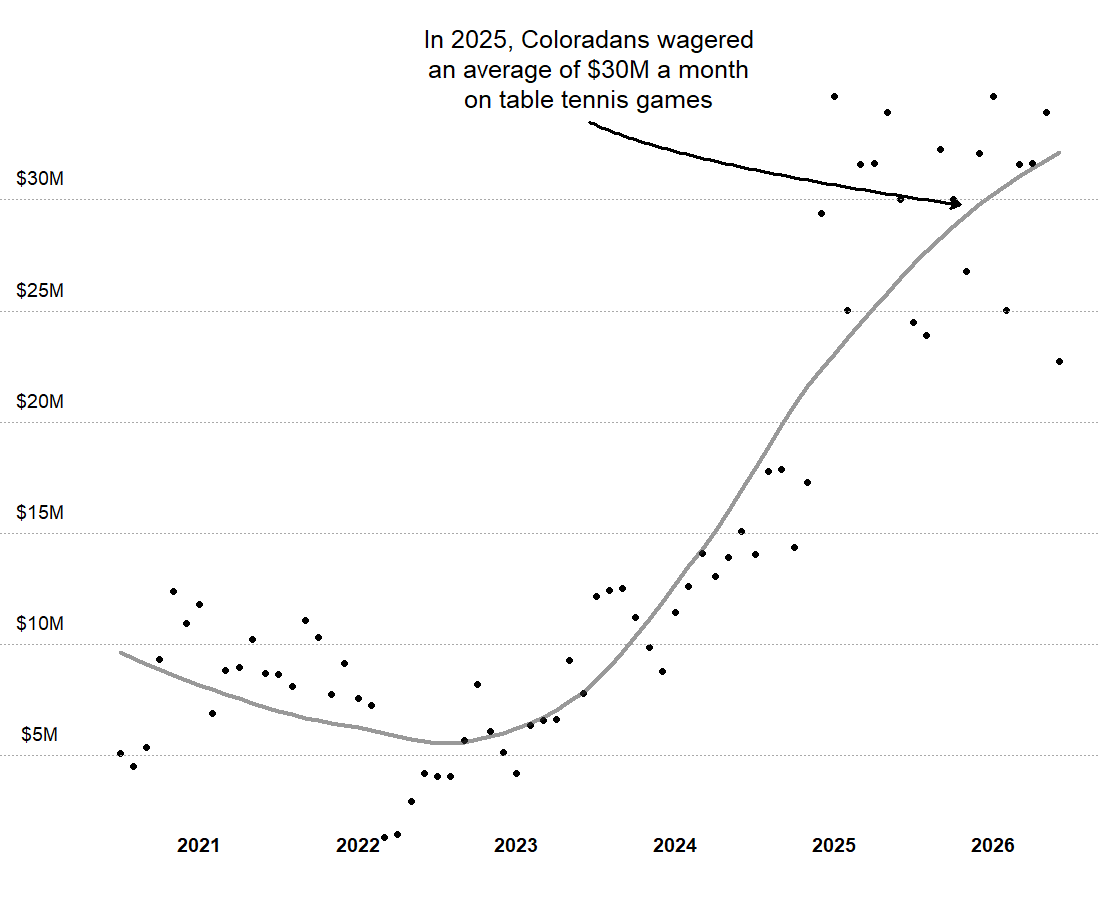
Table tennis may seem like an odd sport to be attracting so much attention (it certainly stood out to me). Apparently, its popularity stems from its constant availability and rapid pace. Where professional sports games can take hours to conclude, a table tennis match might last 20 minutes, and there are table tennis games to place bets on at all hours of the day. A dedicated gambler could place a volume of bets on table tennis games (and different outcomes within them) at a scale that just isn't possible with more traditional sports.
What sports are most profitable for the betting companies?
One thing that complicates any discussion of the overall amount of money that is spent on sports betting is that the companies end up paying out a very significant amount of the total money that is wagered to people who made the winning bets. The difference between the wagers made and the amount paid out is known as the "hold."
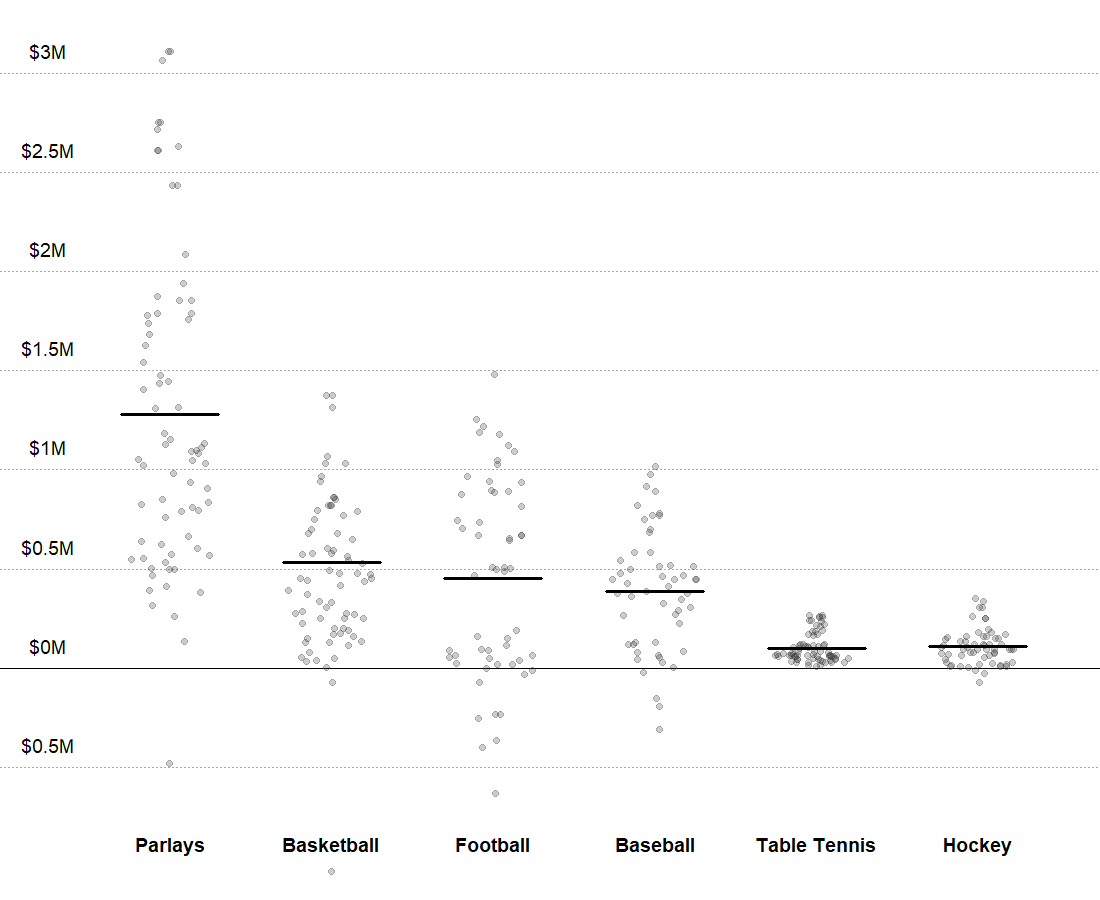
The figure below shows the overall hold for different categories of bets. Parlays bring in the most overall money and has the highest hold percentage (in a typical month, parlays have about a 13% hold rate). This category has also been steadily increasing as an overall share of the wagers made since 2020.
The next highest overall source of gross gaming revenue for the betting companies in Colorado is basketball (although it has a somewhat lower median hold rate compared to the other sports at about 5%). Table tennis is unique among the categories of bets in its consistency. There were no months during this period where table tennis had a negative hold (the betting companies ended up paying out more than they took in wagers), and the median hold percentage (7.5%) was somewhat higher than the median for other individual sports.
The difference between wagers and payouts across different categories in Colorado, 2020-2026
Tax revenue from sports betting
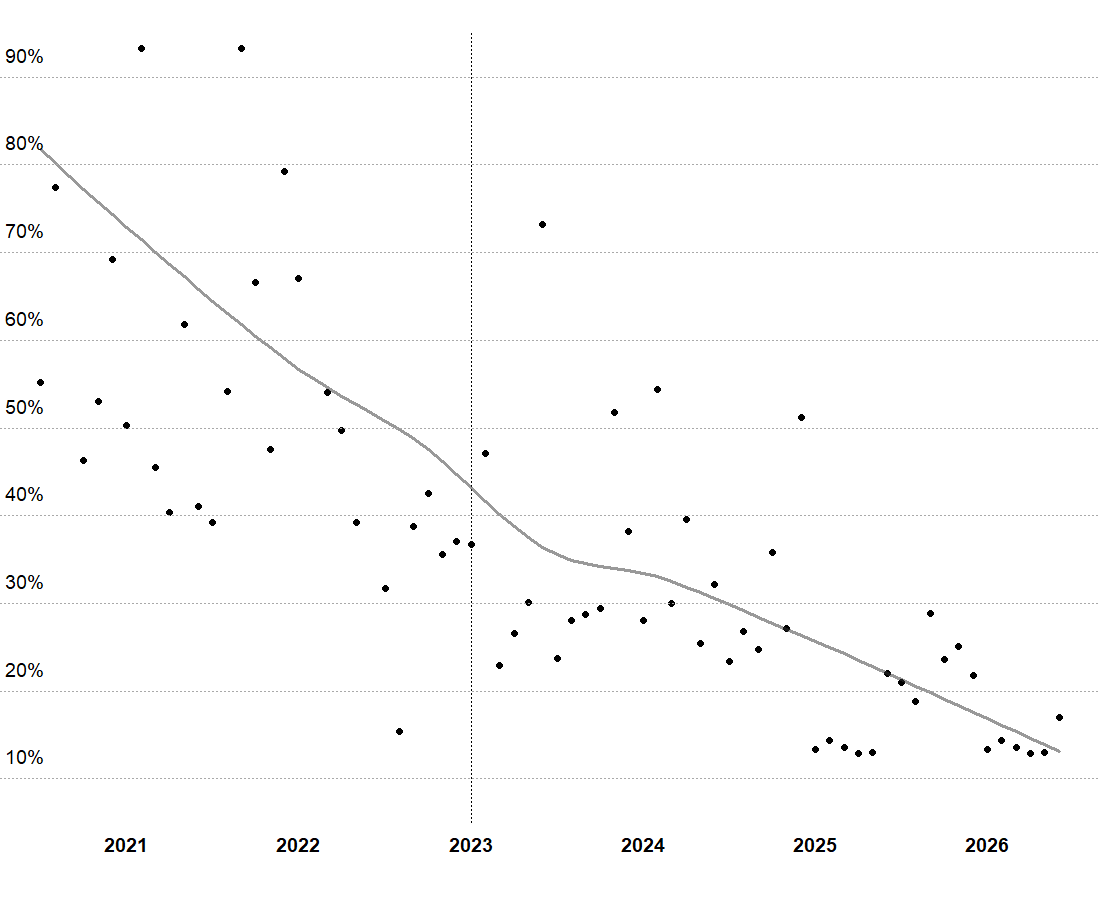
The monthly revenue reports show the gross gaming revenue (GGR) and the taxable "net sports betting revenue" (NSBR) for each month. The difference between these two figures can be instructive. In the early days of online sports betting, Colorado permitted the companies to deduct the cost of promotions (usually offered in the form of sign-up bonuses to individual gamblers; e.g. "bonus bets" where a new signee would get $100 or $150 credited to their account or "safety-net bets" where the company would offer to absorb the losses of an initial bet or rewards for daily betting). That benefit was phased out beginning in 2023.
The graph below shows the proportion of the betting companies' gross revenue that is written off each month. We can see that even before the new policy was implemented (perhaps in anticipation of it?) the share of gross gaming revenue was dropping regularly. In the early part of the trend, it wasn't uncommon to see the sports betting companies deducting substantially more than 50% of their gross revenue. That figure has dropped to somewhat more than 10% in the most recent reports.
Share of gross gaming revenue that is deducted each month in Colorado, 2020-2021
Some concluding thoughts
The rapid growth of online gambling in Colorado warrants closer examination. One striking limitation of the available data is how little we know about who is placing these bets. The public reports tell us billions of dollars are being wagered, but not whether those wagers are spread across hundreds of thousands of casual fans or concentrated among a relatively small number of very active gamblers. That distinction matters. Two states could report the same betting numbers while having very different patterns of gambling behavior, and they could potentially have very different social consequences. Better data on participation, financial outcomes, and problem gambling would go a long way toward helping Colorado evaluate whether its current regulatory approach is working, and whether interventions like the recently implemented limits on credit card use are having their intended effect.
If we suppose that the rates of sports betting in Colorado are the same as they are nationally (~10% of adults), there are likely 500,000 or so Coloradans who bet online at least occasionally. Most behaviors like this follow some kind of power law where a small minority of users place an overwhelming majority of the bets. Some estimates of online betting suggest that about 15% of users account for 80% of gambling on the platform. If that is true in Colorado, about 75,000 people are bearing the brunt of the costs of online sports betting in Colorado (likely betting $10,000s each). The social costs of these problem users is even more difficult to measure, but it is surely significant.