A final(?) word on turnout in the 2026 elections


The ballots have mostly been counted now, and we can take a step back to look at some bigger picture trends throughout the election cycle. The data in this post will again rely on ballot return data. I've collected it through election day for many of the largest counties in the state. The data here cover over 80% of the total ballots distributed.
The gender gap(s) in turnout
There is enough data in the files (~2.8 million ballot records) to show the rates of ballot return by individual year of age and gender. The plot below does so, and two things immediately jump out. First, voting increases steadily with age up to a point (about 75 for women and closer to 80 for men). The youngest Coloradan voters return their ballots at about half the rate of those in their 70s and 80s. The other notable feature of this data is the gender gap among the vast majority of voters that are younger than 74 (which favors women by a few points), and then the reversal of that trend in the oldest part of the distribution.
Ballot return rates by age and gender
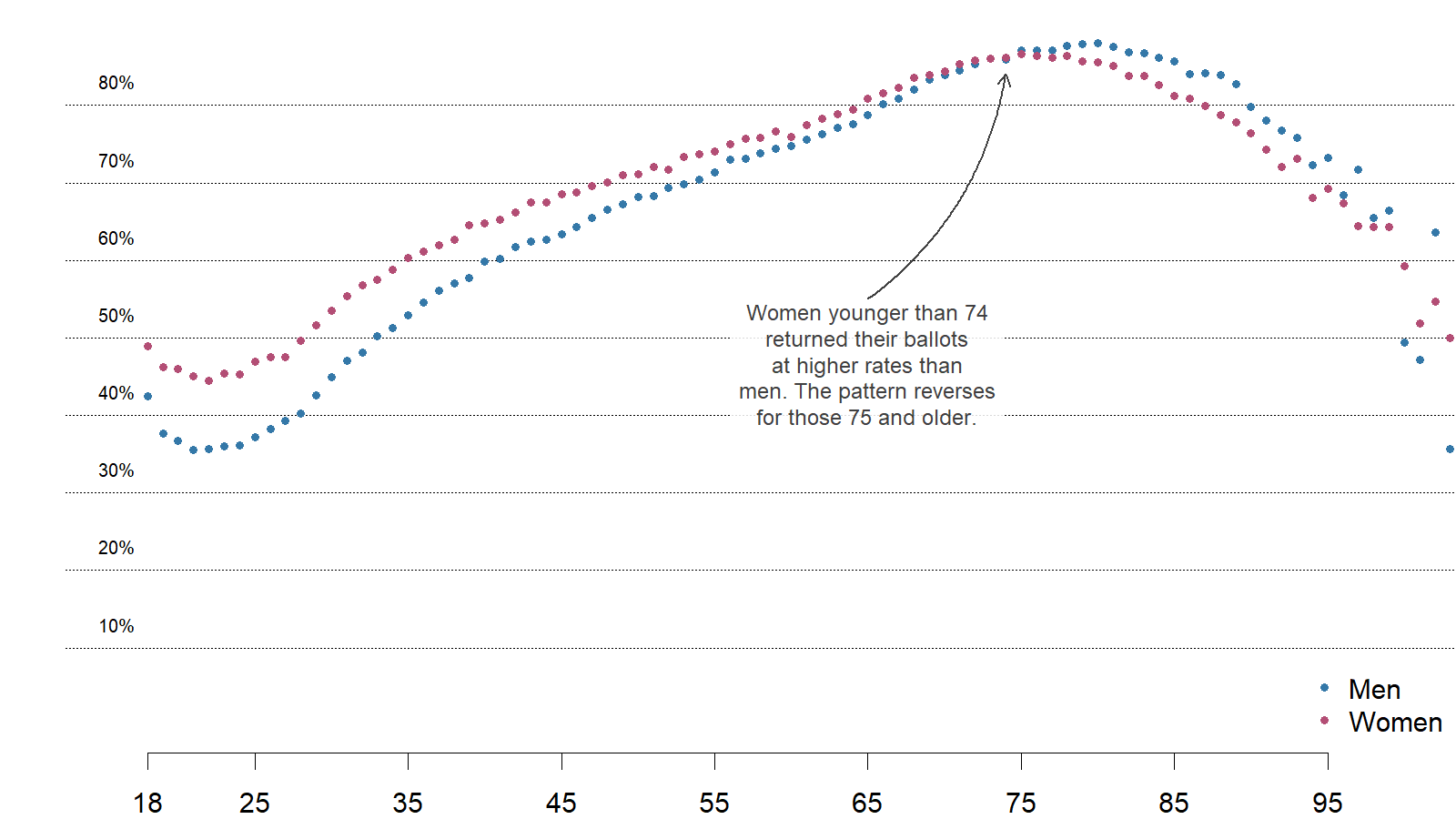
The age/voting relationship is extremely robust, and – as we will see next – acts as a governor on the Democratic balance of politics in the state.
Partisanship by age
The plot below tracks the two-party advantage by age among Colorado voters. For nearly all individual ages younger than 80, Democrats hold a partisan advantage, and the extent of that advantage corresponds to political events. The peak in Democratic advantage among younger people (ages 29-36) corresponds to the cohort that came of political age during the Obama years. The 64 year olds who are about dead even in their partisanship turned 18 in 1980 when Ronald Reagan was promising to "Make American Great Again." The smaller peak among those now in their mid-70s were coming of political age during the Watergate scandal that brought down the Nixon presidency.
Partisan registration advantage among voters and all registrants by age
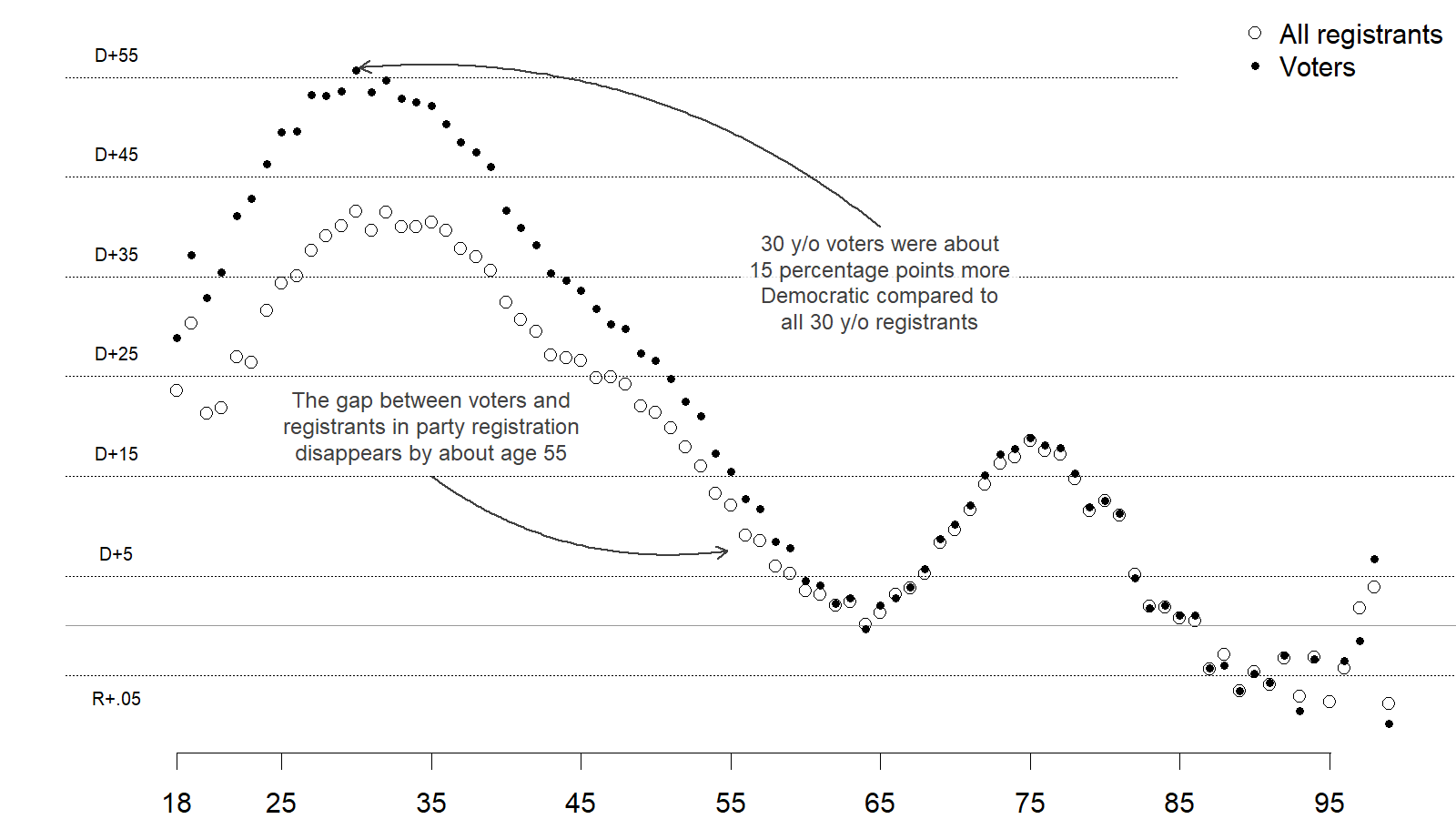
The plot also shows the partisan advantage among those who had turned in their ballots. Voters over 50 showed a persistent (though somewhat narrowing) gap between those who had turned in their ballots and the partisanship of all registrants their age throughout the voting period. For voters 55 and older, the partisan gap showed early in the voting period, but had closed by the time the polls closed.
It is important to remember that party affiliation is not the same as partisan preference. There are surely some voters who are registered with the Democratic Party who cast their vote for a Republican candidate and vice versa, but the measure used here (Democratic advantage in two-party registrations) correlates very strongly at the county level when we look at voting returns (e.g. the counties that had the highest rates of Democratic advantage, gave Weiser his largest margins and those that had smaller Democratic advantages or lean Republican in their composition had much better showings for Marx).
Concluding thoughts
The data here indicate that Colorado is significantly more Democratic in its leaning than even its very blue voting patterns suggest. The combination of lower turnout among younger voters and their significantly more Democratic tint means that a better showing among younger Colorado voters would likely have been enough to give Democrats a clean sweep across Colorado's congressional districts, even larger margins in the state assembly, and several of the ballot measures may have gone a different direction (I'm looking at you, Propositions 134 and 135).
In some ways, the total lack of a statewide campaign in the Colorado may bear some of the blame here. The fact that Marx was such a historically bad candidate and that Mark Baisley had such a low profile meant there was no real incentive for the best resourced campaigns in the state to mobilize young people in Colorado as they were in other places around the country.