How Colorado Politicians are Talking About the Issues

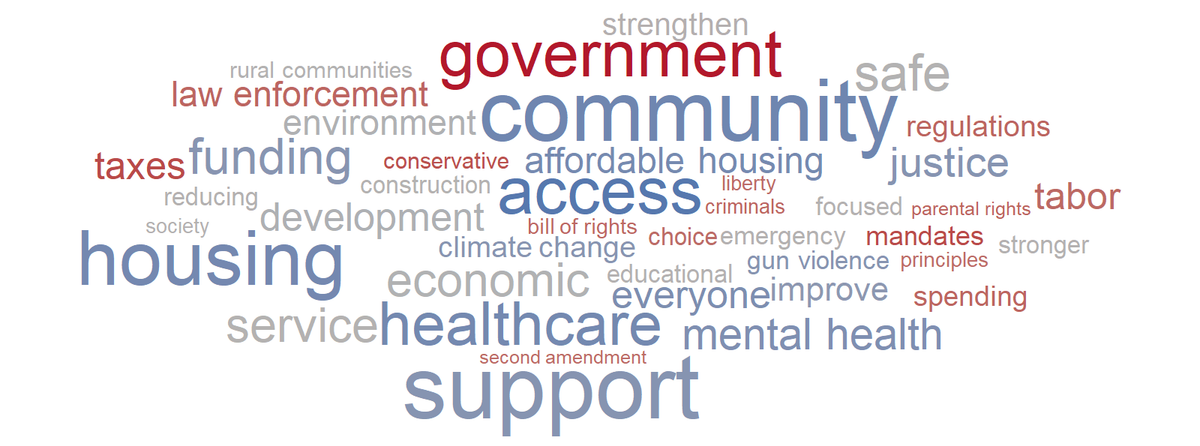
Democrats and Republicans running for the state legislature are presenting themselves in very different ways. They talk about different issues and they talk about those issues in very different ways. Political campaigns are the key connective tissue between candidates and Coloradans. In this post, I'll review some data on how candidates for the legislature are talking about the key issues facing the state.
One of the primary ways that political candidates communicate with their prospective voters is through their campaign websites. These platforms allow candidates to present themselves and their views entirely on their own terms. Candidates (and their staff) craft their messaging in an effort to appeal to voters as well as signal to other interested parties about their priorities.
About the data in this post
For this post, I collected data from all major party candidates running for the state legislature in 2026 (61 Democrats and 55 Republicans running for House seats as well as 20 Democrats and 21 Republicans running for Senate seats). In a handful of cases, I could not locate the candidate's website (and in a few cases, the websites that I was able to find returned errors). For every website I was able to access, I tried to identify two kinds of texts: first, the candidate's description of themselves (usually labeled "Meet ___" or "About ___"); second, the candidate's statements on their issue positions (usually labeled, "Issues," "Platform" or "Priorities"). Overall, the data includes more than 175,000 words (11,606 unique words). Social scientists have developed a number of methods for the quantitative analysis of text data, but in this post, I will try to keep things as straightforward as possible.
Partisan divides in language use
It is not necessarily surprising that Democratic and Republican candidates for office use distinctive language when discussing themselves and their issue positions. Partisans place different degrees of emphasis on issues and points of their biographies that becomes immediately obvious on perusing even just a few of these websites.
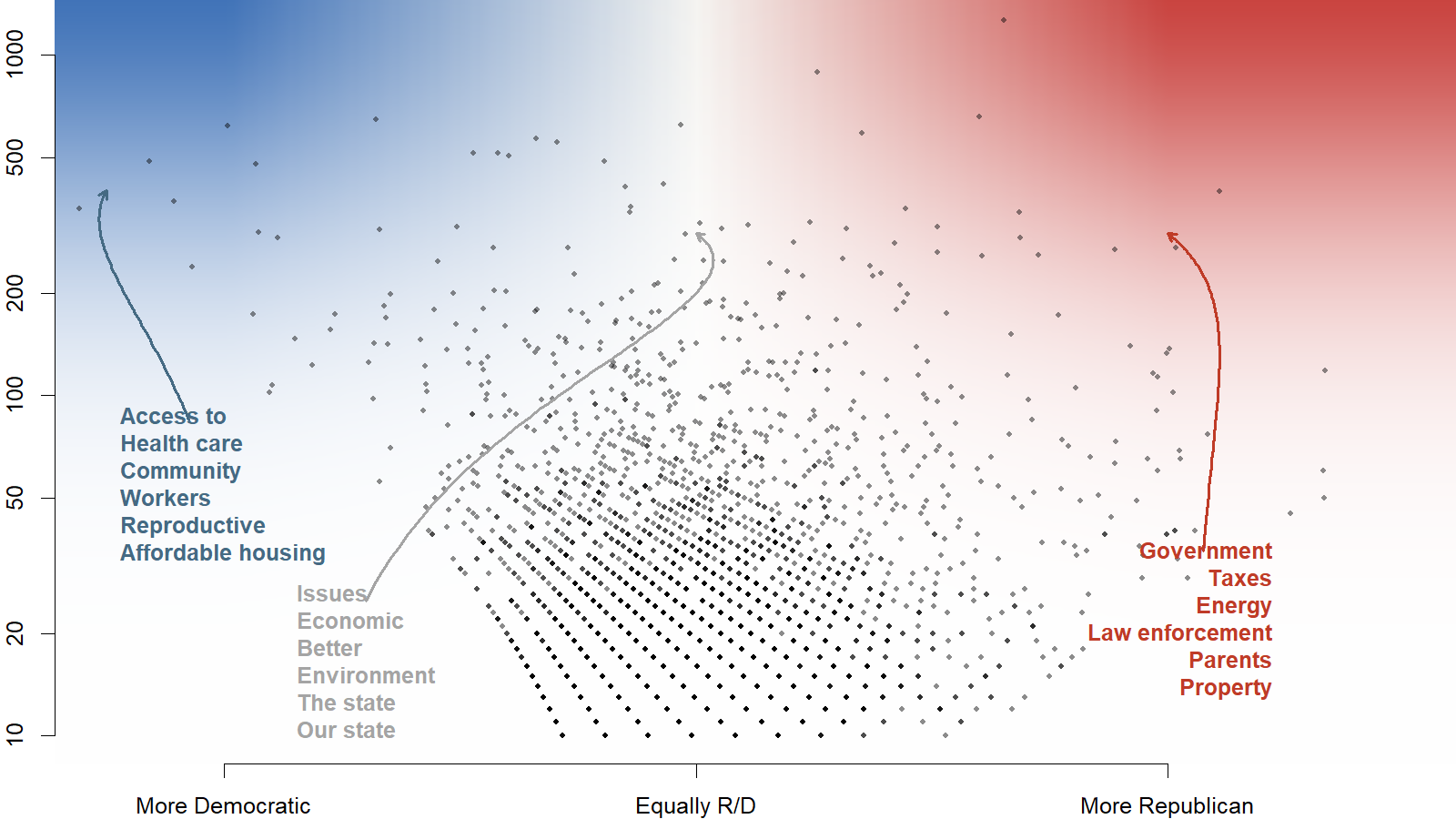
The figure below uses a method developed by some political scientists to visualize the partisan divide in the way these candidates use language in their websites. The method produces a score for each word based on the relative frequency that it appears in Democratic and Republican sources. As can be seen in the graphic below, this score is a function of the total number of times the word appears in the data as well as how lopsided those appearances are.
Frequency and partisan distinctiveness of words and phrases
Language divides among partisans in competitive races versus those in safe seats
We can apply the same method to other divides beyond partisanship. For example, is there a difference in the ways that Democrats running for safe seats talk about these issues compared to those in more competitive districts?
The table below shows the top terms used by Democrats in safe versus competitive districts. The safe district column shows the top words that distinguish candidates running in safe districts (those that went 60% or more for Harris in 2024) and those that are running in more competitive districts. The "Both" column shows the words that did not distinguish between these candidates.
| Safe districts | Both | Competitive districts |
|---|---|---|
| Gun | Meet | Rural |
| Protections | Proud | Water |
| Access | Fair | Veterans |
| The right | Communities | Sponsored |
| Justice system | Invest | Agriculture |
| Transportation | Parents | Wildfire |
| Immigration | Public | Education |
| Emissions | Energy | Military |
| Prevention | Advocate for | Roads |
| Crisis | Work to | Tax credits |
Democrats in safer districts are more likely to talk about gun control, immigration and climate issues compared to those in competitive districts who are more likely than their co-partisans to talk about conservation and environmental issues ("water," "wildfires"). The differences also reflect the geographic divide in Colorado. Almost all urban districts are solidly Democratic in their voting patterns (accounting for the distinctiveness of "transportation" among the safe district words). The less safe districts for Democrats were more likely to be rural districts (accounting for "rural" and "agriculture" among the distinctive concerns of these candidates). Many of the candidates running in competitive districts also highlight their military backgrounds.
Republicans' language was not as clearly divided by the competitiveness of the district they are running in.
How the candidates talk about specific issues
Part of the differences in language use by Republicans and Democrats is due to differences in the issues that they talk about, but partisan differences in language persist within specific issue areas. One straightforward way to look at this is in terms of collocation (e.g. words that are located near each other in the text of the website).
What the candidates say they will fight for
When we look at the words that are associated with "fight," "confront," "combat," "stop," "stand up" and related concepts, we see their priorities in their own words.
Unsurprisingly, both Democrats and Republicans running for the state legislature say they will fight for Colorado and Colorado families. Democrats say they are fighting for public schools, communities, healthcare and affordability. Republicans place more emphasis on rights and freedoms, the second amendment, and fighting against government.
Education
When we look at words that are collocated with terms associated with education, a sharp partisan divide emerges. For Democrats, the most common collocate is "public" followed by "funding," "support," and "community." For Republicans, the most common words are "choice" and "parents." In general, Democrats place much more emphasis on supporting teachers and funding public schooling. Republicans focus on "school choice" signaling their enthusiasm for charter schools. They also repeatedly talk about "parental rights."
Economy
On the economy, the most common word for both Democrats and Republicans was "small" as in "small business." Both parties also emphasized "housing" (most often in the context of rising housing costs). Democrats placed relatively more emphasis on "workers" and "working families" where Republicans were much more likely to emphasize "energy" as well as government interventions ("regulations," "mandates," "taxes").
The issue of the Taxpayer Bill of Rights (TABOR) is in the background of many of these discussions of the economy. About half of Democrats running for the legislature and somewhat more than half of Republicans mention TABOR in their websites. Democrats who discuss TABOR do so in terms of the restrictions that it places on governance and their hopes for reform or repeal. Republicans talk about TABOR in terms of protecting it and guarding the taxpayer rebates that it promises.
Healthcare
Democrats were substantially more likely to discuss healthcare in their websites compared to Republicans. Democrats talk about this issue in terms of "access," "affordability," "costs," and "systems." When Republicans talk about healthcare issues they are significantly more likely to talk about rural communities and also in the context of affordability. Democrats wrap together
Immigration
Immigration doesn't figure prominently in many candidates' websites. Colorado is not a border state, and immigration is a federal issue. However, when the issue does come up Democrats talk about it in terms of "support" and "rights" as well as how it intersects with their personal stories. Republicans who talk about the issue do so in terms of "enforcement," "security" and use descriptors like "illegal."