Cast Vote Records in the 2026 Democratic Primary in Denver
Analysis of the ballots cast in the 2026 primary election reveals the diversity of the electorate.

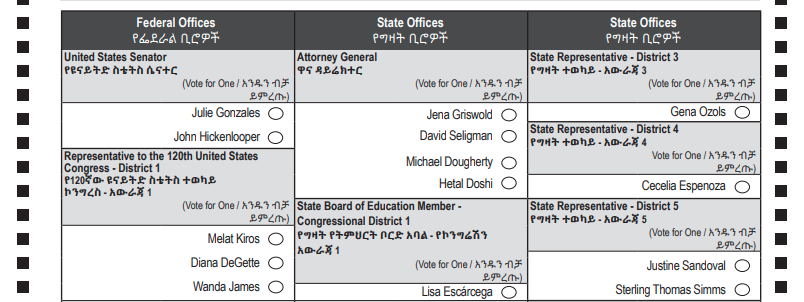
Now that the election results have been certified, we have access to the "Cast Vote Records" (CVR) for the 2026 election. These CVR files include ballot-level voting information from the election, so we can see the joint voting patterns (e.g. voters who supported both Gonzales for U.S. Senate and Melat Kiros for CD-01).
About the data used in this post
In this post, I'll be unpacking some insights from the Denver county cast vote records file (available here). Residents of Denver city and county account for 12% of the total votes cast in the 2026 primary, and almost all of the first district is contained within Denver (it contains very small portions of Arapahoe and Jefferson counties as well).
The diversity of voting patterns in the electorate
One of the features of this data that is immediately apparent is just how varied the preferences of the electorate are. For example, if we look at the Democratic side at just the races for the nominations for the highest-profile offices (governor, U.S. Senator, U.S. representative, secretary of state, attorney general), there are 96 potential combinations of choices that could be made (not including the small share who did not make a valid choice for a particular office), and all of these combinations are represented among the ballots cast.
The most common pattern of votes is found in 16% of the Democratic ballots cast in the primary (Weiser for governor, Julie Gonzales for senate, Kiros for CD-01, Seligman for Attorney General, and Amanda Gonzalez for Secretary of State). Only 4% of voters cast ballots that matched the winners for the county in these races, and just over 1% of Denver Democrats cast ballots that matched the statewide winners for these races.
The graphic below is a version of an "UpSet" plot which shows the overlap in the coalitions for the Democratic nominations for governor, senator and representative in Denver. Overall, 158,869 voters participated in the Democratic primary in Denver. A little over a third (35%) of these voters supported Weiser in the gubernatorial primary, Gonzales in the senate primary and Kiros in the nomination for CD-01. The next most common combination of support was voters who supported Bennet for governor, Hickenlooper for senate and DeGette for representative. Twice as many Denver Democrats supported the "outsider" ticket (Weiser / Gonzales / Kiros) compared to the more establishment ticket (Bennet / Hickenlooper / DeGette).
Combinations of candidate support in the 2026 primary among Denver Democratic primary voters (governor, senate, house)
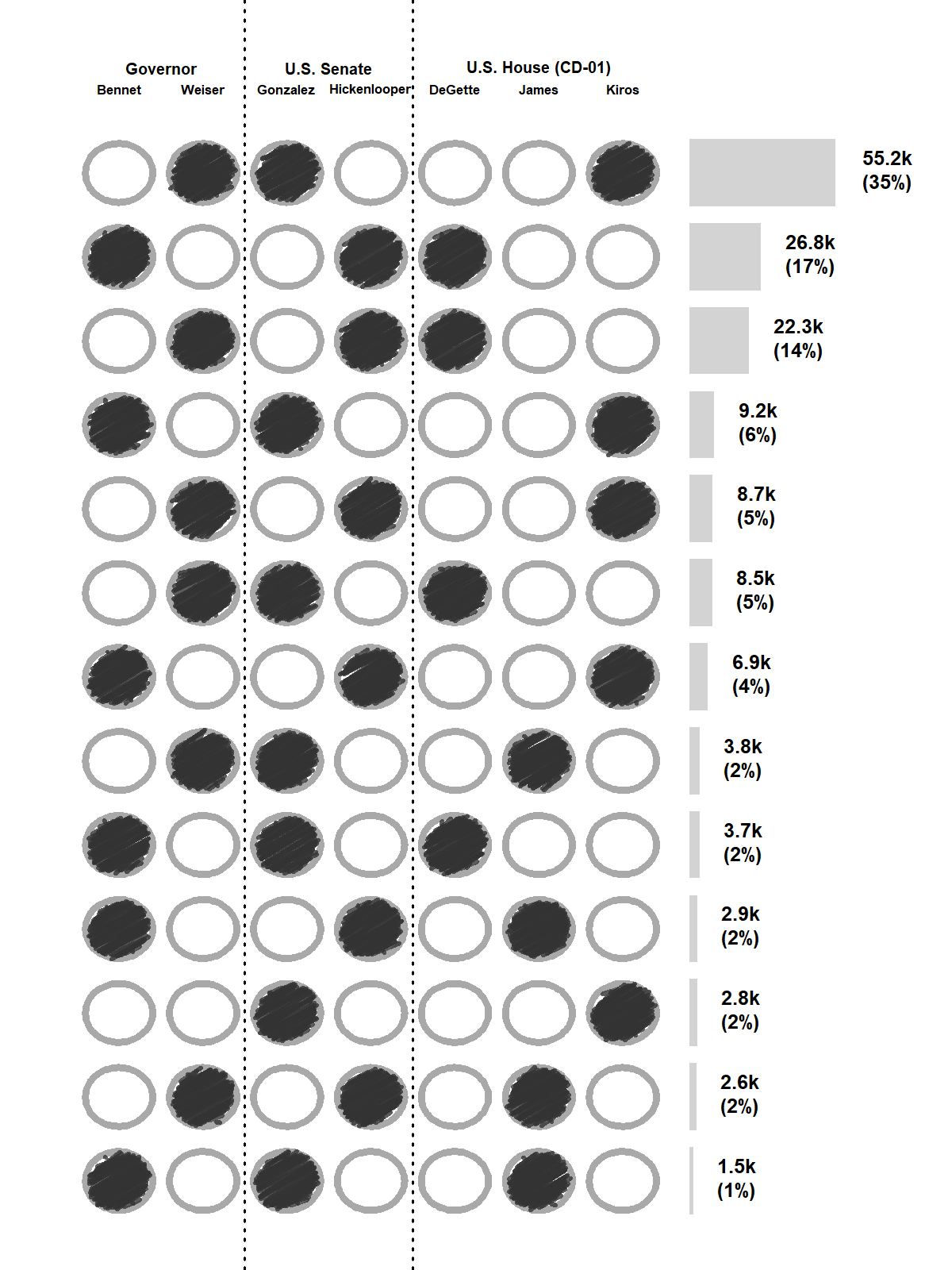
The third most common voting pattern in the primary for these three races was Weiser / Hickenlooper / DeGette (14% of Denver Democrats). Each of the top three combinations (accounting for 70% of the total votes cast) make a certain amount of sense for political observers. The long tail of combinations are more ... idiosyncratic. For example, more than 15,000 Kiros voters also voted for Hickenlooper for senate (19% of her total votes in Denver). More than 12,000 Gonzales voters supported DeGette in the house primary (14% of Gonzales's Denver votes).
Inferring candidate placement from CVR data
Another way we can use this data is to measure the similarity of different candidates' coalitions. For example, were the other candidates supported by Wanda James's voters more similar to those of DeGette or Kiros? The figure below shows how voters for each candidate for CD-01 voted across other parts of their ballots for the highest profile races on the ballot.
Patterns of support for other candidates among voters for ...
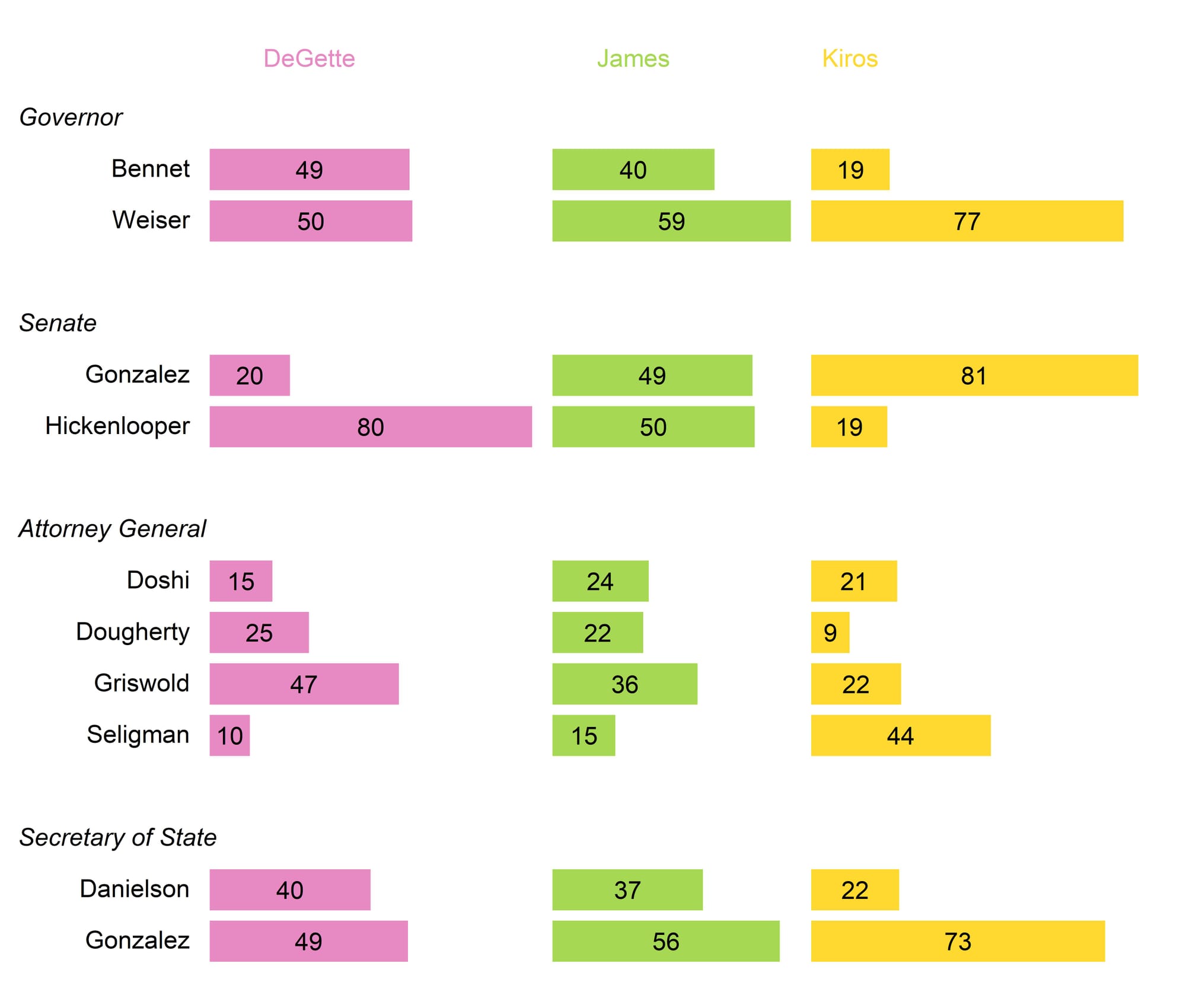
Voter choices in the first district are significantly related to their choices for other candidates. For example, if we look at choices for governor, we can see that an overwhelming share of Kiros voters supported Weiser compared to the share who voted for Bennet (77% to 19%). DeGette voters were very evenly divided in their choices for governor with about half supporting each candidate. James voters favored more for Weiser though a significant share voted for Bennet (40%).
We can apply this approach across the entirety of the ballot to quantify the similarity between the choices made by these candidates' supporters. When we look across the entire ballot, James's voters are somewhat more similar to DeGette's voters overall than to Kiros's voters. Based on data from the other races on the ballot, James's voters might have swung toward DeGette by a margin of about 10 percentage points. It should be noted that even if all of James's voters had supported DeGette, it wouldn't have changed the outcome of the race.
Concluding thoughts
The analysis in this post underscores a point that I tried to make recently about the trouble with reading too much into election results. Only 1% of the Denver Democratic primary electorate supported every winner in the major races of the election. Even if people wholeheartedly supported every candidate they voted for (an extraordinarily heroic assumption), only the slimmest majority of the public would end up being perfectly satisfied with the results of this election.
Additional analysis
I ran out the below plot and decided that it wasn't contributing much to the overall post. Since it had already been created, I've included it here for those who might be interested.
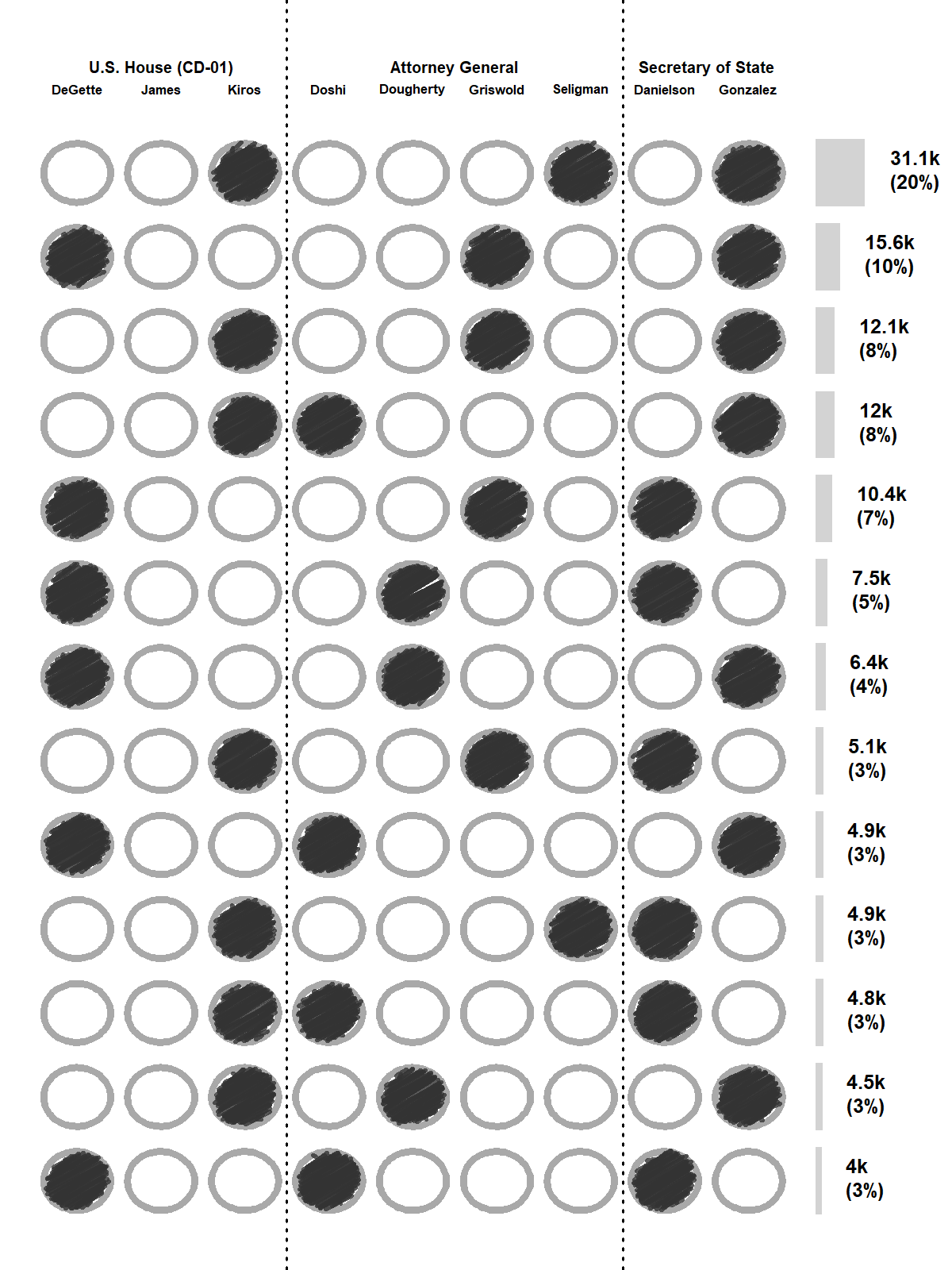
The plot below shows another set of candidates. There is much less concentration for these races (indicating a broader variety of vote patterns in the electorate). The most common pattern among Denver Democrats for the combination of CD-01, attorney general, and secretary of state was Kiros / Seligman / Gonzalez (20% of voters).
Combinations of candidate support in the 2026 primary among Denver Democratic primary voters (house, attorney general, secretary of state)