Colorado's "Hook and Squeeze"
Colorado Democrats have been using unsustainable fundraising tactics that threaten to burn out donors and increase cynicism.


Some Colorado Democratic candidates appear to be drawing heavily from the same fundraising ecosystem that Stanford political scientist Adam Bonica has recently identified as a growing problem for the national Democratic Party.
In a recent analysis of millions of campaign-finance records, Bonica documents the rise of "spam PACs" that use high-volume, high-pressure fundraising appeals to extract large numbers of small contributions. These tactics seem to be disproportionately effective among older donors. His findings raise an important question for Colorado: how deeply have these tactics penetrated Democratic politics here?
Bonica has contributed greatly to our understanding of campaign finance in the United States, making his analysis particularly valuable. I have used his data in the past on this site. His Substack piece includes a replication archive that permits researchers to independently check his work. It also allows us to pull out some Colorado-specific data from his excellent work. To what extent are Colorado Democrats employing these same tactics?
About the data used in this post
Bonica has built his academic career on wrangling the huge and unruly datasets created by campaign finance disclosure reports released by the Federal Election Commission and a patchwork of state agencies that oversee campaign spending. He includes a lot more detail in his post (which you really should read), but, in short, these data data includes information about individual donors to campaigns and allows researchers to identify a set of political fundraising organizations that seem to follow a similar playbook. These spam PACs inundate their mailing lists with demands for donations. They often use hyperbolic rhetoric or other scare tactics to try to "hook" their prospective donors, and then once they have them they put on the "squeeze." Bonica's piece documents the sad stories of several victims of these organizations who end up donating tens of thousands of dollars in small increments.
Another hallmark of these organizations is how much of their budgets are fed back into fundraising. Altogether, the rise of these groups on the Democratic side has led to a dramatic decrease in the efficiency of fundraising investments. According to Bonica:
One important note is that Bonica looks only at the Democratic side of this issue in his analysis (and consequently in his replication materials which I will be relying on in this post). He notes repeatedly in his writeup that Democrats who employ these methods are following a Republican strategy that proved counterproductive for them.
The spam PACs identified by Bonica all share a common set of characteristics:
- They receive a disproportionate share of their contributions from donors who have given more than 100 contributions in the same cycle
- The large majority of their donors are 65 or older
- They tend to spend significant amounts of their budgets on fundraising in an inefficient way (e.g. the return to their fundraising spending is lower than other organizations)
- They contract with high-volume fundraising vendors
In this post, I'll take a close look at the extent to which these predatory fundraising practices have infected Colorado politics.
CO-04: The burnt-over district
One striking feature of these data is how many of these worrying fundraising indicators show up prominently among Democratic contenders for the fourth district. As will be seen below, the candidates for the fourth show the greatest overlap in their donor bases with the spam PACs. Many of these candidates were also some of the biggest spenders on the high-volume contacting methods vendors, and the age profiles of their donors are among the oldest in the state.
Long-shot, Democratic challengers to high-profile Republicans in relatively safe seats (like Lauren Boebert) seem to attract these kinds of fundraising methods. The spam PAC tactics thrive in these conditions.
In preparing this analysis, I reached out to several recent Democratic candidates who have run in the fourth district (Eileen Laubacher, Trisha Calvarese, John Padora and Ike McCorkle) in an attempt to understand more about their campaigns. In an interview with Padora, he told me:
...
Every Democrat in Colorado sends out fundraising emails invoking Lauren Boebert’s name—Joe Neguse, Jason Crow, Brittany Pettersen—they all do it. ... Boogeyman fundraising works really well. It’s why Democrats at the national level prefer midterm cycles where they can run on opposition ("look what Trump’s doing"). It’s an effective way to raise money.
Source: Interview with John Padora, Aug. 24, 2026. Lightly edited for readability. You can access the full interview transcript here.
The overlap between the donor bases of Colorado Democrats and spam PACs
One indicator of the health and sustainability of a fundraising operation is the extent of the overlap between the donors to a campaign and the set of spam PACs. As Bonica notes in his piece, many of the donors to spam PACs are being taken advantage of and have made hundreds or thousands of contributions to Democratic causes at the expense of their personal needs.
The graphic below shows the overlap between the donors to major Democratic candidates running for federal office in Colorado and the donors to spam PACs between 2023 and 2025. The graphic shows the extent to which these spam PACs have been successful in reaching rank-and-file Democrats of all stripes.
Julie Gonzales had the lowest proportion of her individual contributions from individuals who had also given to at least one of these spam PACs, but even so 15% of her total individual contributions came from these individuals. At the other end of the spectrum, four out of every five dollars raised by Trisha Calvarese during this period came from individuals who had already given to at least one spam PAC (40% of those dollars came from individuals who had contributed 20 times or more to these organizations).
Share of each candidate's individual contributions that come from those who have also donated to a spam PAC ...
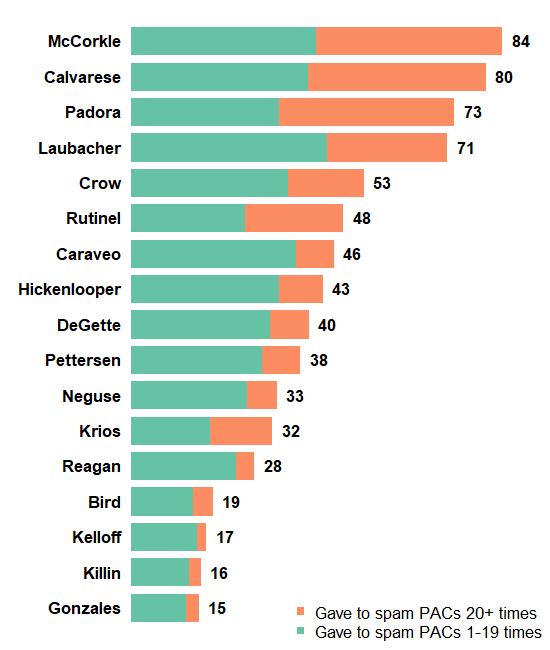
It is important to note that the mere fact that a Colorado candidate shares donors with donors to spam PACs does not necessarily imply that they are using the same tactics as those spam PACs. The extent of the reach of these spam PACs means that it is basically impossible for any Democratic candidate who is engaged in fundraising at the scale necessary for federal office to not end up incidentally sharing donors with these spam PACs.
Which Colorado Democrats are hiring high-volume vendors?
In his analysis, Bonica notes that a minority (~20%) of Democratic candidates directly hire the same organizations that employ high-volume contacting efforts as the spam PACs. This set of Democrats raises substantially more money from donors who have contributed to spam PACs compared to other Democrats who are not hiring these same firms.
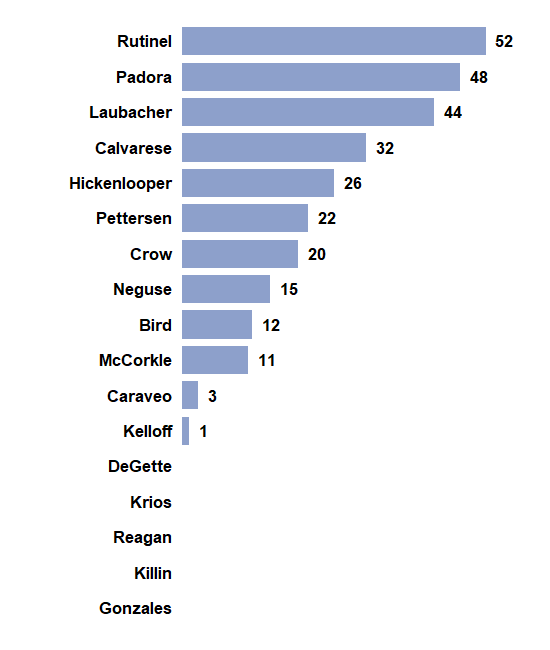
In Colorado, several Democratic candidates have spent considerable shares of their 2025 budgets hiring these same high-volume firms as those used by spam PACs. Again, it is important to note that many of these firms do more than just high-volume contacting efforts and the fact that a candidate is hiring one of these firms does not necessarily mean that they are using the same tactics in their outreach.
Share of each candidate's 2023-2025 expenditures made on high-volume contacting vendors
Distributions of age among supporters of Colorado Democratic candidates
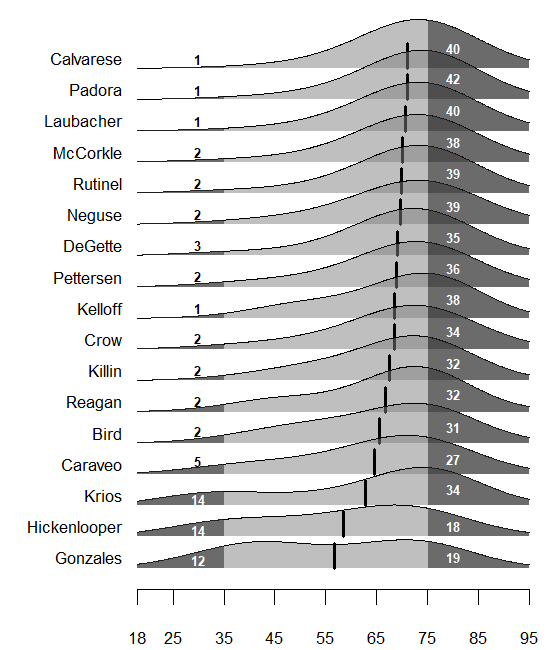
Donors to political candidates tend to be older on average than others. The graphic below compares the distributions of ages among each candidate's donors. One finding that is immediately obvious is how similar the age distributions are for many of the candidates for the house of representatives in Colorado. For many of the candidates, the average age of donors is about 70 and roughly 40% of their donors are over 75. The campaigns for the senate nomination (Hickenlooper and Gonzales) show the greatest diversity in terms of the age of their donors.
Distributions of age among individual donors to Colorado Democratic candidates (2023-2025)
Some concluding thoughts
Taken together, the evidence suggests that Bonica's concerns about Democratic fundraising are not merely a Washington problem. Colorado's Democratic campaigns draw heavily from the same donor pool that sustains the spam-PAC ecosystem, some campaigns are spending substantial sums with the same high-volume fundraising vendors, and in several cases (particularly in the fourth district) their donors exhibit many of the demographic and behavioral characteristics that Bonica associates with these organizations.
None of this proves that a particular Colorado candidate is deliberately employing the same tactics as a spam PAC, and the overlap in donors is not, by itself, evidence of wrongdoing. But it does suggest that the incentives and infrastructure Bonica describes have made their way into Colorado politics. The more troubling question is what happens when a political fundraising system becomes increasingly dependent on donors who can be persuaded to give again and again, while ever larger shares of the money raised are spent simply on asking them for more.
This is a fundraising system that appears increasingly exploitative and difficult to sustain. Colorado politicians can and should do better.