Gubernatorial primary update: Q1 2026


This post will provide an update based on the latest campaign finance disclosure filings for the major candidates for the race for governor in Colorado. Others have covered the total amounts raised by each candidate. My analysis will center on what we might be able to learn from the past behavior of donors to these candidates. For background on the methods and results from the 2025 totals, see my previous posts: this one for the Democrats and this one for the Republicans.
The Democrats
The latest campaign filings for the Democratic primary for the Colorado governor race show that – at least in overall number of donors and their past histories – the dynamics of the race have not fundamentally changed. As was the case in my first post looking at the race between Bennet and Weiser, both candidates have roughly the same number of contributors (14,033 for Bennet and 13,888 for Weiser), and when we look at the past behavior of these donors we can see that not much has changed from 2025.
Previous Polis donors
As noted in my previous analysis of the race for the Democratic nomination, Jared Polis's largely self-funded campaigns in 2018 and 2022 have left Bennet and Weiser without a large base recent gubernatorial donors to draw on.
Overlap in the donor bases of Polis, Bennet and Weiser
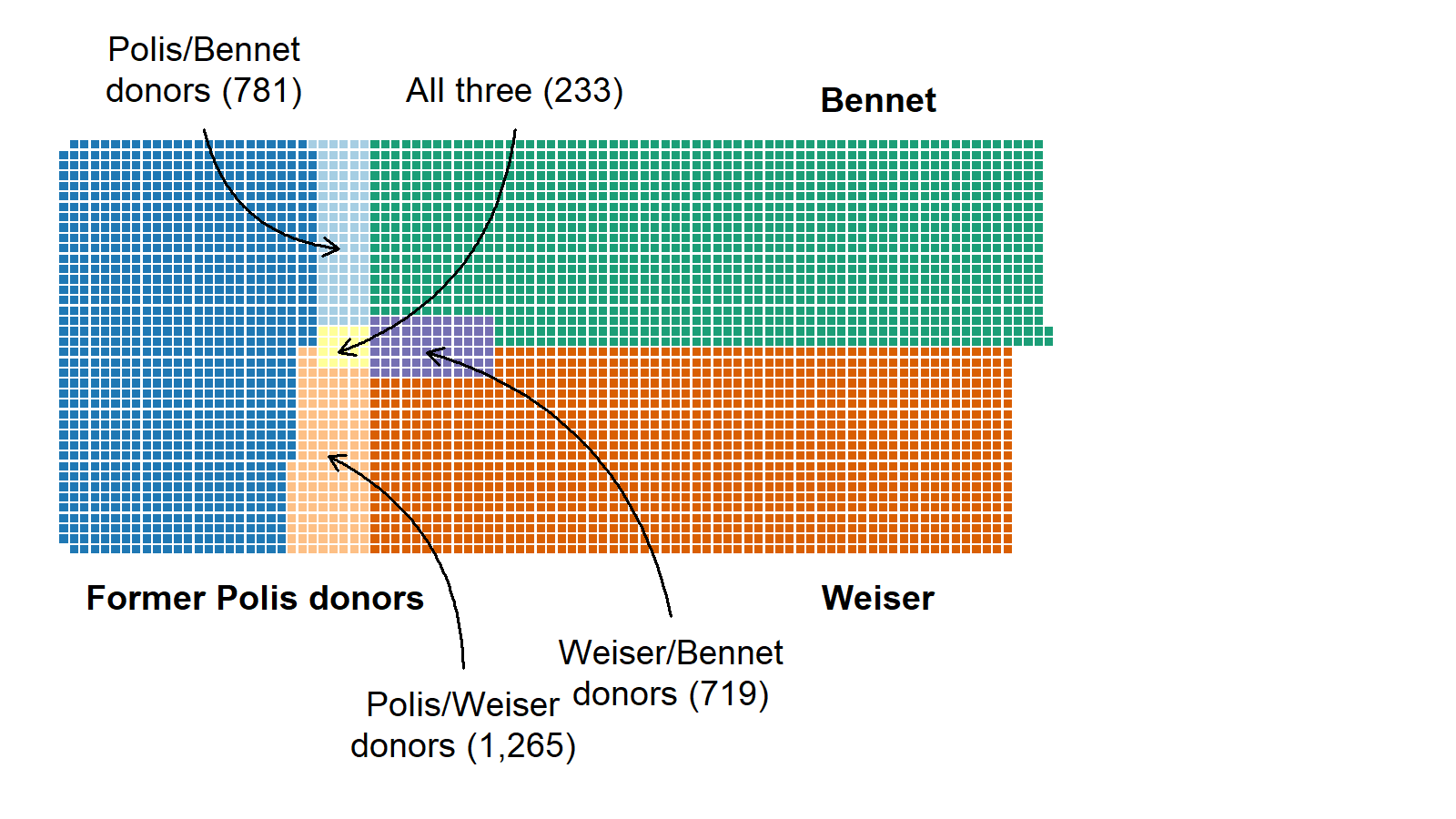
Weiser has retained his lead among former Polis donors. About 11% of donors to the Weiser campaign previously contributed to Polis. This compares to just over 7% of Bennet donors who previously supported Polis's campaigns.
Retaining previous donors
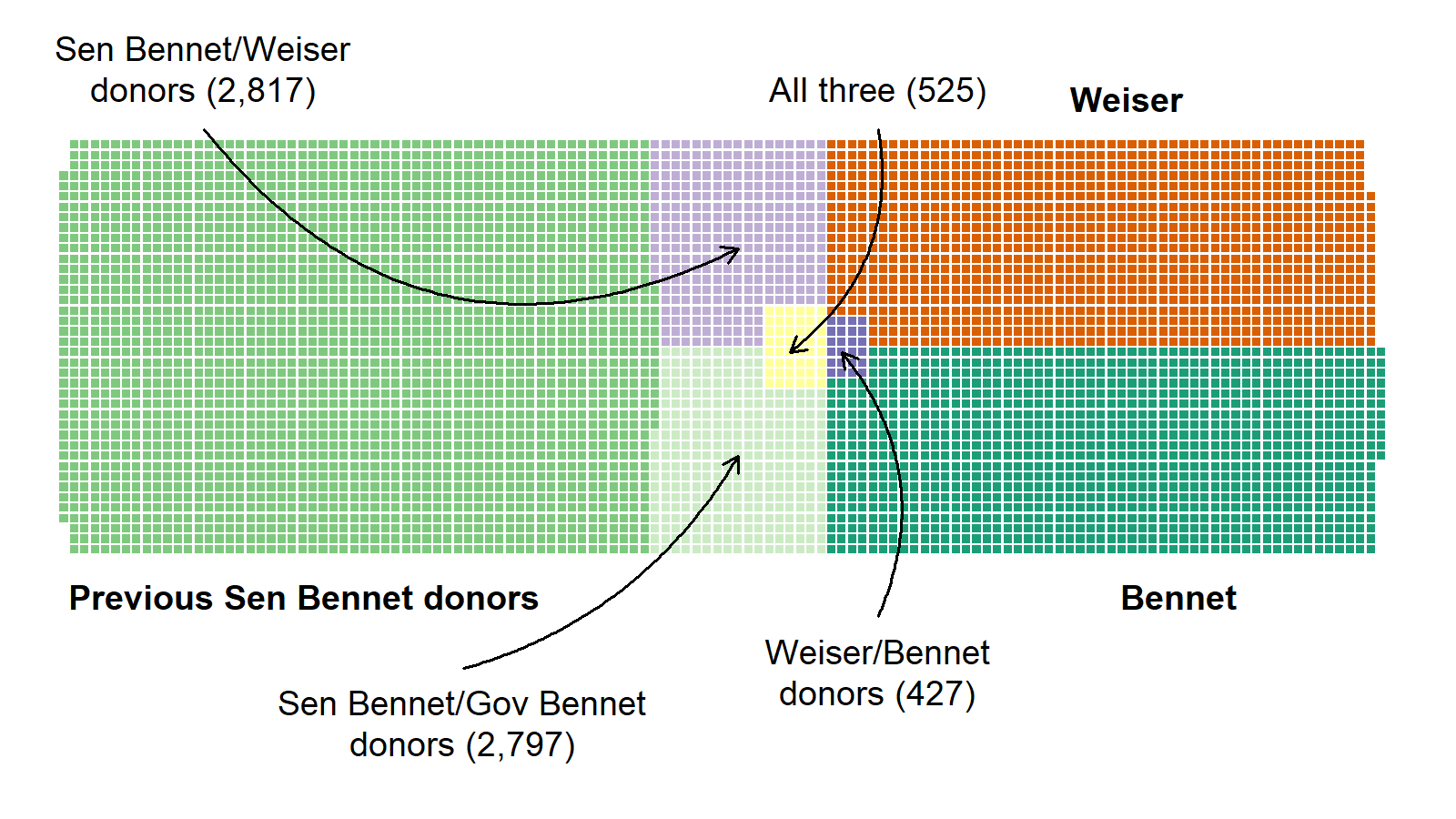
As both Bennet and Weiser have won (and are currently serving in) statewide office, each has a significant network of past donors. Bennet's campaigns for the senate have been higher profile, and consequently he has a substantially larger of network of donors to draw on compared to Weiser. Despite this apparent disadvantage, Weiser has been more successful at activating his donor network, and he has been about as successful as Bennet himself in getting contributions from donors that have previously given to Bennet's senate campaigns.
Bennet's campaigns for the senate have collected contributions from about 30,000 Coloradans. Both Bennet and Weiser have received a little over 3,000 contributions from donors that have given to Bennet's senate campaigns in the past. If anything, Weiser has slightly more contributions from these previous Bennet donors than does Bennet himself.
Overlap between the donor bases of Bennet's senatorial campaign and the Bennet and Weiser gubernatorial campaigns
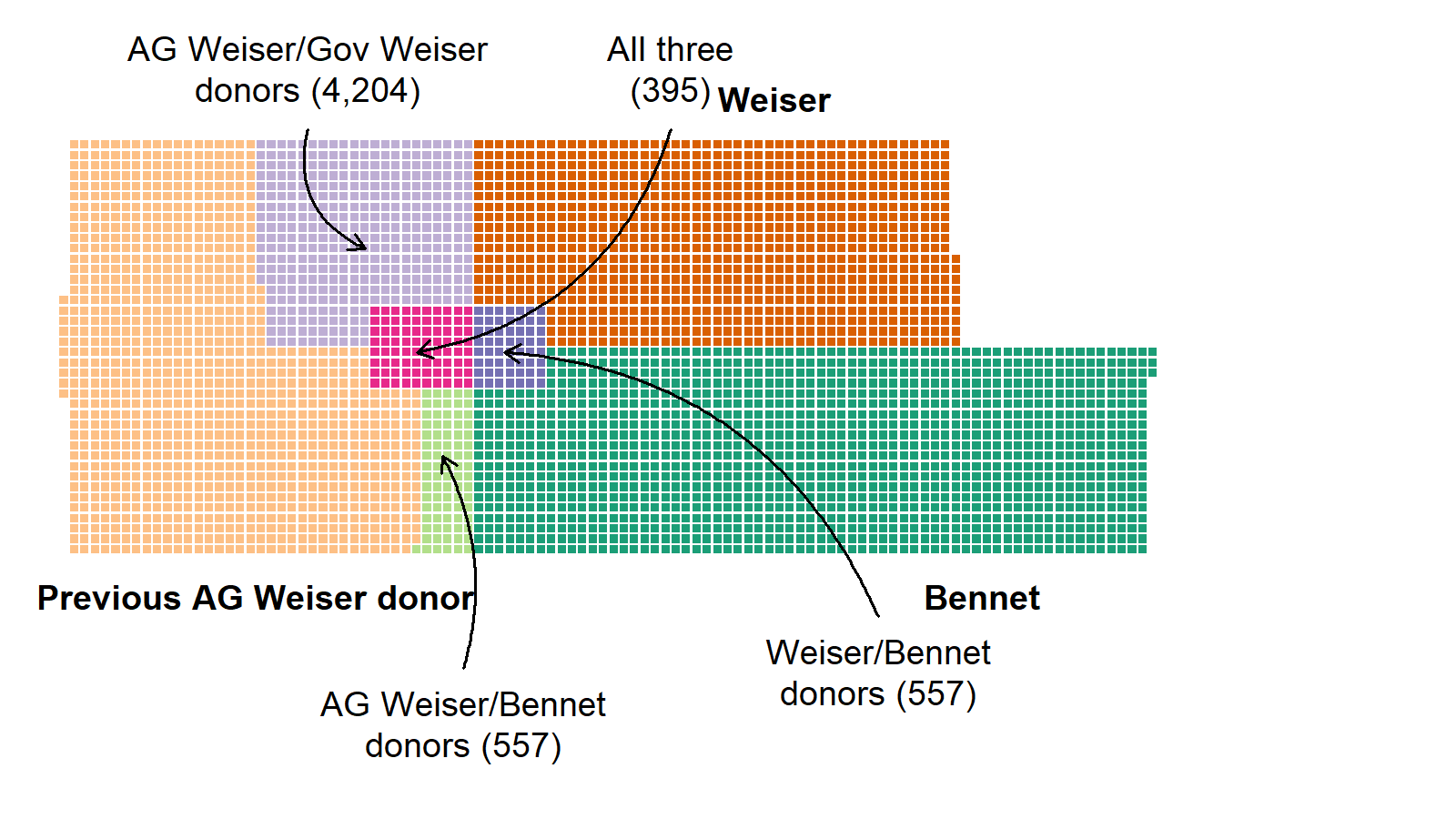
When we look at a similar analysis of donors to Weiser's campaigns for attorney general, we see a very different pattern. Weiser has received contributions from about a quarter of his previous AG donors while these same donors have been much less likely to contribute to Bennet's campaign for governor.
The Republicans
The 2026 first quarter fundraising numbers were substantially more impressive for Marx than Kirkmeyer or Bottoms. Marx outraised Kirkmeyer more than tenfold in the first quarter with more than $1.6 million in contributions to Kirkmeyer's $127,000. Bottoms' first quarter contributions were even less impressive with just over $67,000. I estimate that Marx has received contributions from almost 17,000 individual donors while Kirkmeyer's total is substantially more modest at just under 1,000 individual donors, and Bottoms comes in last again with only 700 individual contributors. As I wrote in my previous analysis of the Republican nomination campaign, Kirkmeyer's chances looked dim going into 2026. Her poor showing in the first quarter of this year does not bode well for her chances to claim the nomination.
My last analysis of this race did not include State Representative Bottoms' unlikely candidacy for the nomination. Bottoms – a two term state representative from the Colorado Springs area – has courted controversy with allegations of "pedophile rings" throughout the Colorado government (the latest in a string of unsubstantiated conspiracy theories he has refused to provide any evidence for). In the April caucuses, Bottoms claimed the top spot among Colorado Republican delegates.
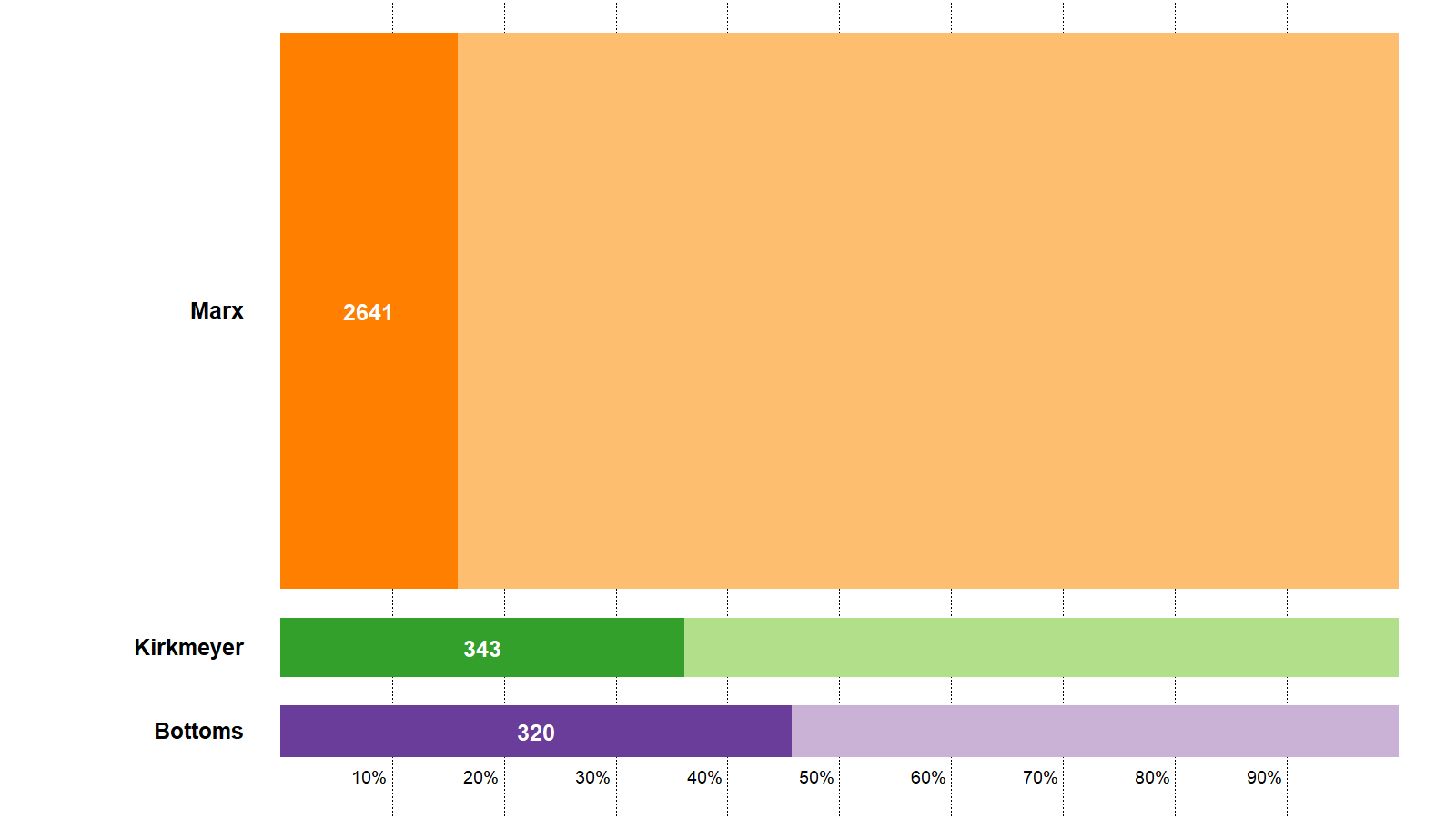
The graphic below shows the share of each candidates' donors who have previously donated to one of Trump's presidential campaigns. Kirkmeyer has received a somewhat higher proportion of her total donations (about a third) from those who previously gave to Trump compared to Marx but much fewer total donors than Marx. About 15% of Marx's donors previously gave to Trump. Roughly half of Bottoms' donors previously gave to Trump, but in absolute terms, he has the least number of Trump donors total.
Share of donors to ___ who have previously contributed to Trump
Concluding thoughts
As I tried to stress in my first posts on the "invisible primary," it is important not to place undue emphasis on campaign finance numbers. These posts attempt to peel back one layer from the raw number of dollars and contributions to get some signal as to the kinds of support each candidate is receiving, but they are still only one data point when assessing the overall state of the race.
On the Republican side, the overwhelming advantage that Victor Marx holds over his competitors makes it difficult to see a situation where he does not end up with the nomination, but stranger things have happened in politics.
The Democratic side is much more interesting as the candidates are relatively evenly matched in terms of the amounts they have raised. Individual contributions aren't the only part of the story however. The analysis here doesn't consider Super PAC spending which is likely to be a significant factor.