The direct impact of rising gas prices on Colorado residents
This post explores the impact of rising gas prices on Colorado households.

Rising oil prices have far-reaching impacts throughout the economy. Nearly everything in the modern economy depends in some way on oil, but while many of those costs are indirect and diffuse, the price of gasoline is felt immediately by most Colorado households.
In this post, I'll look at a couple of sources of data to estimate the direct costs of increased gasoline on family budgets across Colorado. To do so, we'll need a few different data points:
- How much gas does the typical Colorado household consume?
- What is the cost of gas?
It is relatively easy to find the latter (AAA, for example, publishes the average cost of gas at the county level), but determining how much gas the typical Colorado household consumes is more difficult. For the purposes of this analysis, I'll infer gas consumption from driving data collected by the Bureau of Transportation Statistics.
A note about the data
The Bureau of Transportation Statistics published (in 2024) estimates of the average number of miles driven in each Census tract (this data goes by the acronym LATCH: Local Area Transportation Characteristics for Households data). This data can be used to understand geographic variation in the amount of driving by Coloradans. We're missing one additional piece of information that would be necessary to more precisely estimate household gas consumption: fuel efficiency. Try as I might, I couldn't find any good data on the composition of different types of vehicles in Colorado. In the analysis that follows, I'll show the variation in the estimates under different assumptions about fuel efficiency.
LATCH data in Colorado
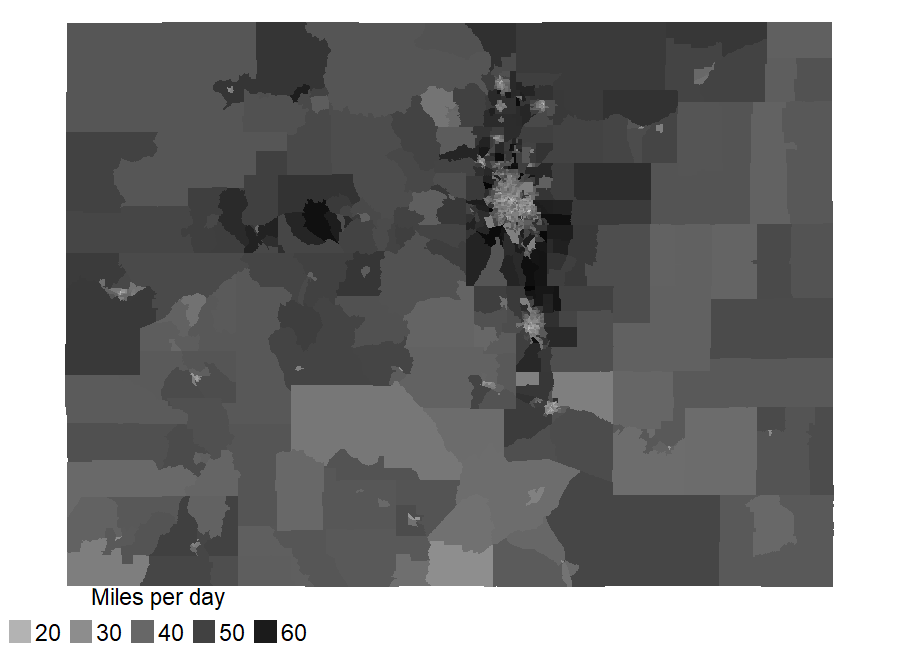
The figure below shows the LATCH estimates for Colorado Census tracts. People living in urbanized parts of the state drive significantly less than those in outlying suburban portions of the state. Overall, the LATCH data estimates that the average Colorado household drives about 24 miles per day. This figure ranges from households in the most densely populated parts of the state that drive fewer than 15 miles per day on average, to some suburban places where households drive more than 60 miles per day.
Average miles driven by Census tract
Gas prices
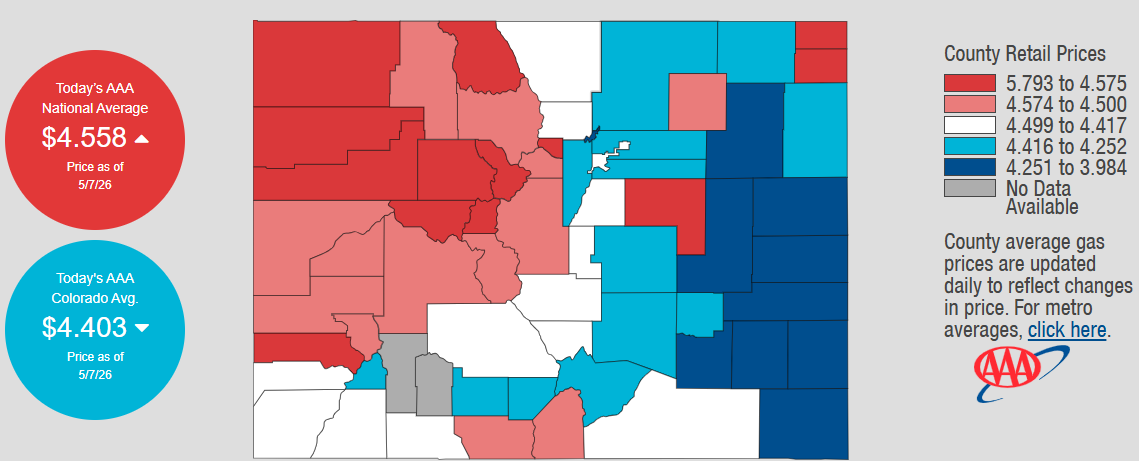
Gas prices generally follow a east/west divide in the state with the eastern (and especially southeastern) parts of the state having somewhat lower gas prices than the mountainous regions in the west and north part of the state. The central (most populous) part of the state typically have prices in the middle.
Gas prices in Colorado, May 2026
Fuel efficiency
To bring these two sources of data together, we need to make some assumptions about fuel efficiency. Overall, the EPA estimates average fuel efficiency of the mix of cars on America's roads at 27.2 miles per gallon – a figure that has increased from about 12 miles per gallon in 1975. Electric vehicles have made a significant (though still relatively modest) impact on that trend, and within Colorado, about 4% of the cars on the road are electric. The electric vehicles in Colorado are almost all concentrated in the Front Range counties that already have lower than average miles driven. According to estimates that I could find, Colorado's overall average fuel efficiency is very close to the national figure.
Total costs
= Miles driven per household × Number of households
= 24 × 2.4 million
= 57.6 million miles
Estimated gasoline consumption
= 57.6 million miles ÷ 27.2 MPG
≈ 2.1 million gallons per day
For basically all of 2025, gas prices hovered around $3.00 per gallon. They had declined somewhat at the beginning of 2026, but prices have shot up dramatically over the course of the Iran war. As of early May, the average cost of a gallon of gas had risen 50% over its 2025 average representing an increase of about $1.50. At current prices, Colorado households are paying an extra $3,300,000 every day.
As we saw above, this cost is not evenly distributed over the state. In the more populous regions, the burden is somewhat lower due to less reliance on driving and a more efficient mix of vehicles (including a higher share of electric vehicles). In less densely populated parts of the state, households drive substantially more and tend to have less efficient vehicles. Together this means the impact of higher gas prices can be up to six times more significant for Coloradans in smaller towns and suburban areas compared to those living in the more densely populated regions.
Concluding thoughts
As many commentators have noted, higher gas prices make every gas station price display a billboard against the president. Americans often seem to blame presidents for things like rising gas prices, but rarely can voters so directly tie specific decisions of a president to something that has so clearly raised their costs. Given the relationship between urbanicity and voting patterns in Colorado (and most of the rest of the country), higher gas prices are having a substantially greater direct impact on areas that supported Trump over Harris in 2024. A great deal of recent polling shows that Trump's approval has been slipping among groups that are important to his political coalition (see this recent Pew report for a good breakdown).
According to some economists, the Iran war could lead to a global recession that would have much more significant impacts on Coloradans than the price of gasoline. The indirect economic impacts of rising oil prices won't be fully felt for months or years.