The partisan gender gap in Colorado
The gender gap in partisan affiliation has shrunk somewhat over the past 20 years. Women remain more likely than men to identify or lean toward the Democratic Party than men.


This is the last post in a short series on partisanship in the general public in Colorado. The first post on generational differences (which also describes the data and the method) is here, and the second on education and race/ethnicity differences is here.
Gender gaps in partisan identification and vote choice have been a feature of American politics since at least the 1980s. The Center for American Women and Politics has shown that women have been more likely than men to support Democratic presidential candidates in every presidential election since 1980. Women have also been more likely than men to identify or lean toward the Democratic Party at the national level. CAWP data also show that women have consistently registered and turned out to vote at higher rates than men for at least the past 40 years.
Partisanship by gender among Colorado adults ...
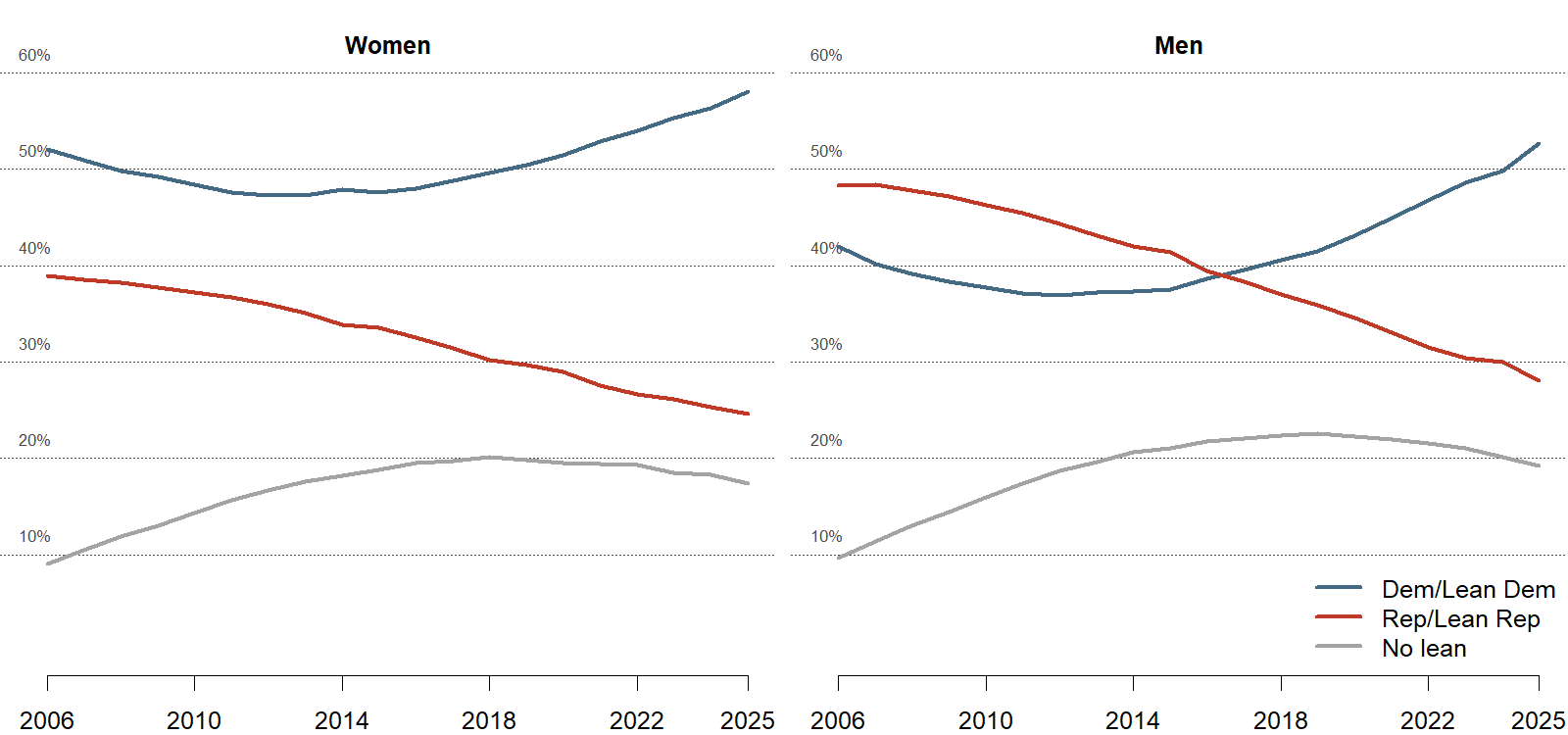
The partisan trajectories of men and women in Colorado have followed roughly parallel paths. After a slight downward trend in the mid-2000s and early-2010s, men and women both started moving in a more Democratic direction. During this same period, the shares of both men and women who identify or lean toward the Republican Party have declined at a steady pace. During the first decade of this time series, there was also a roughly equal increase among men and women in the share who say they have no partisan affinity.
Partisan balance by gender among Colorado adults ...
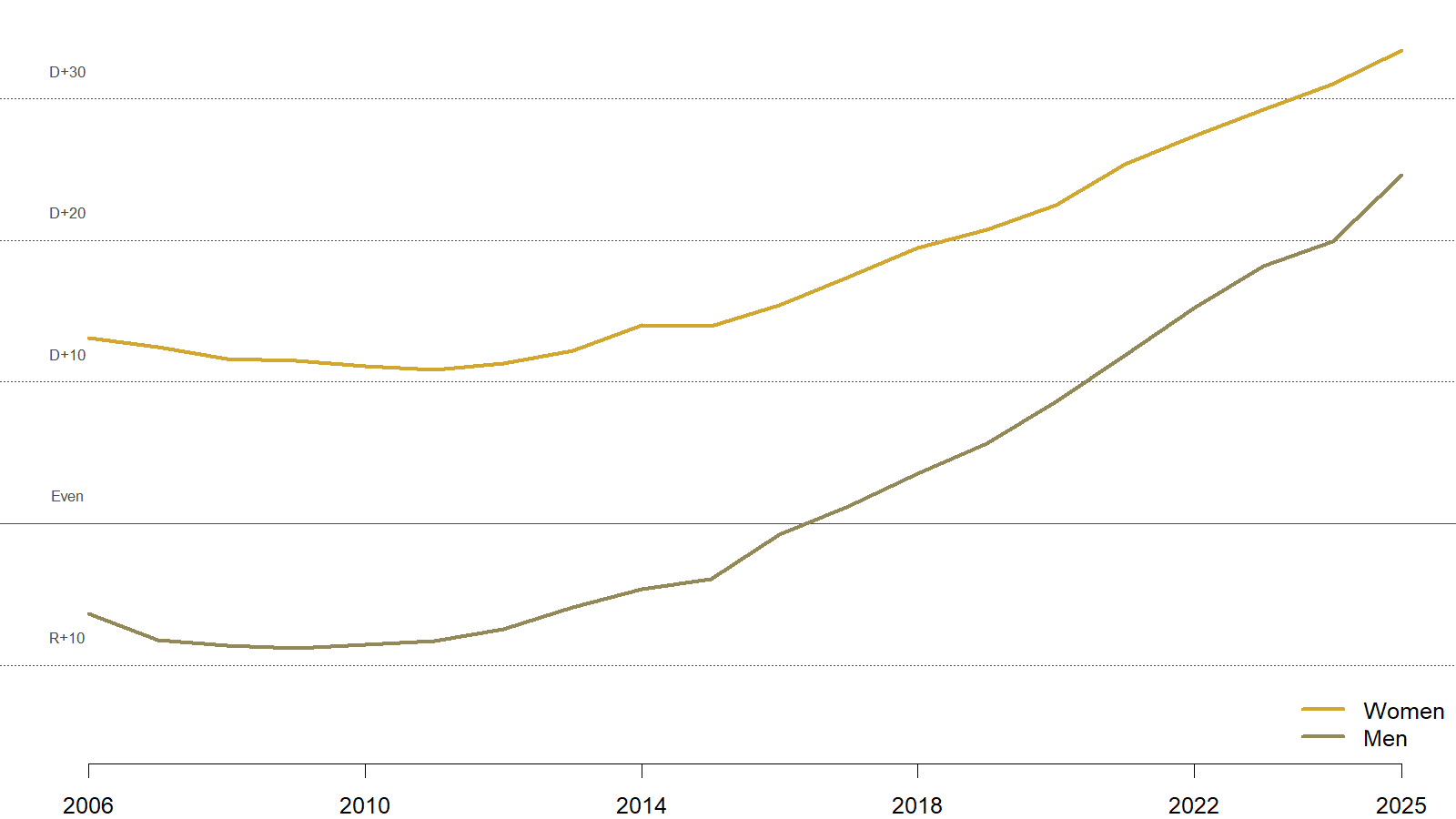
The gender gap in Colorado has narrowed somewhat over the past two decades. Twenty years ago, nearly half of Colorado men identified or leaned toward the Republican Party. Today, somewhat less than 30 percent of men in Colorado affiliate in some way with the Republican Party. Women in Colorado began at a lower point (about 40 percent identified or leaned toward the Republicans) and about a quarter affiliate with the GOP today. Today, somewhat more than half of Colorado men and nearly 60 percent of Colorado women identify or lean toward the Democratic Party.
Concluding thoughts
Shifts at the level of partisan identification tend to be sticky. Political scientists and pollsters have compiled a large body of evidence showing that partisanship generally changes only slowly (usually on the scale of decades), and the impacts of partisanship are wide and deep. In any given survey, partisan differences are likely to dominate all other differences on any topic that is adjacent to politics.
This is not to say that the Democratic advantage in Colorado is fait accompli. The greatest political changes in Colorado have coincided with Trump's ascendancy in Republican politics. People sometimes overstate how much of a departure Trump has been from the trajectory that the GOP was already on rather than the product of movements that had already been in place, but it would also be wrong to say that he hasn't had some independent effect on the state of the party. As I write this, the U.S. is getting more and more embroiled in its war of choice with Iran. It is difficult for me to imagine a different Republican president having taken the same increasingly irrational and erratic steps toward military and economic disaster as we've witnessed over the last few days.
Trump's mark on the Republican Party is likely to outlive him, and the Colorado Republican Party has proven itself to not be a serious organization, but things can always change in politics.