Partisanship among Coloradans: Educational divides
Partisanship and political outcomes in the U.S. have become increasingly linked to levels of educational attainment. This post unpacks the diploma divide within Colorado using individual-level survey data.


This is the second in a series on individual-level partisanship in Colorado. The first post is here.
Partisanship and political outcomes in the U.S. have become increasingly linked to levels of educational attainment. I outlined this at length in a previous post, and while the individual-level data that I will discuss in this post does not have the temporal reach of that previous analysis, the story at the individual-level reinforces that overall story.
For more on the data used here see the discussion in my last post.
The diploma divide at the individual level
The figure below represents the Colorado public at two points in time (2006 and 2025). To understand the dynamics of partisanship over time, we have to account simultaneously for the changing composition of the population (increasing shares with a college degree and a growing population overall), and the changing relationship between education and partisanship (the gains Democrats have made among those with and without a college degree). Each square in the chart below represents 10,000 Coloradans, and they are organized into educational and partisan groupings.
Partisan composition of Coloradans by educational attainment, 2006 and 2025
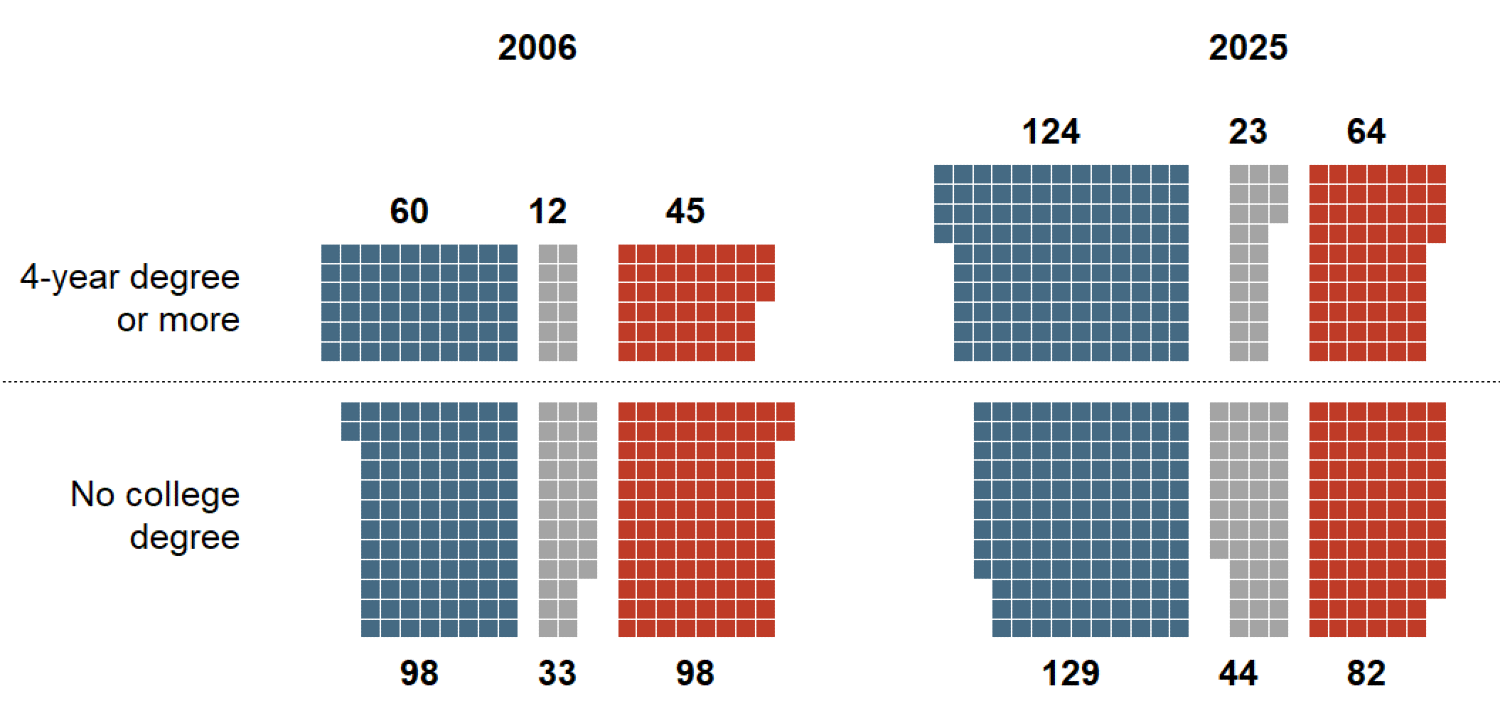
Twenty years ago, only about a third of Colorado adults had a four-year college degree or more education. Today, nearly half (45%) have a college degree, and those with a college degree are about twice as likely to be Democratic as they are to be Republican. Democrats have also made significant inroads among those without a college degree. Numerically speaking, there are actually fewer Republicans without a college degree today compared with 20 years ago (there were about 980,000 in 2006 and only 820,000 today).
In 2006, those without a college degree were about as likely to be Democrats as they were to be Republicans. Today, Democrats have a significant advantage among non-college educated Coloradans as well (though not to the same degree as is true among those that have a college degree).
The relationship between education and partisanship is stronger among White Coloradans. The graphic below shows the Democratic advantage among White Coloradans for those with a college degree and those without.
Democratic advantage among White Coloradans by education, 2006-2025
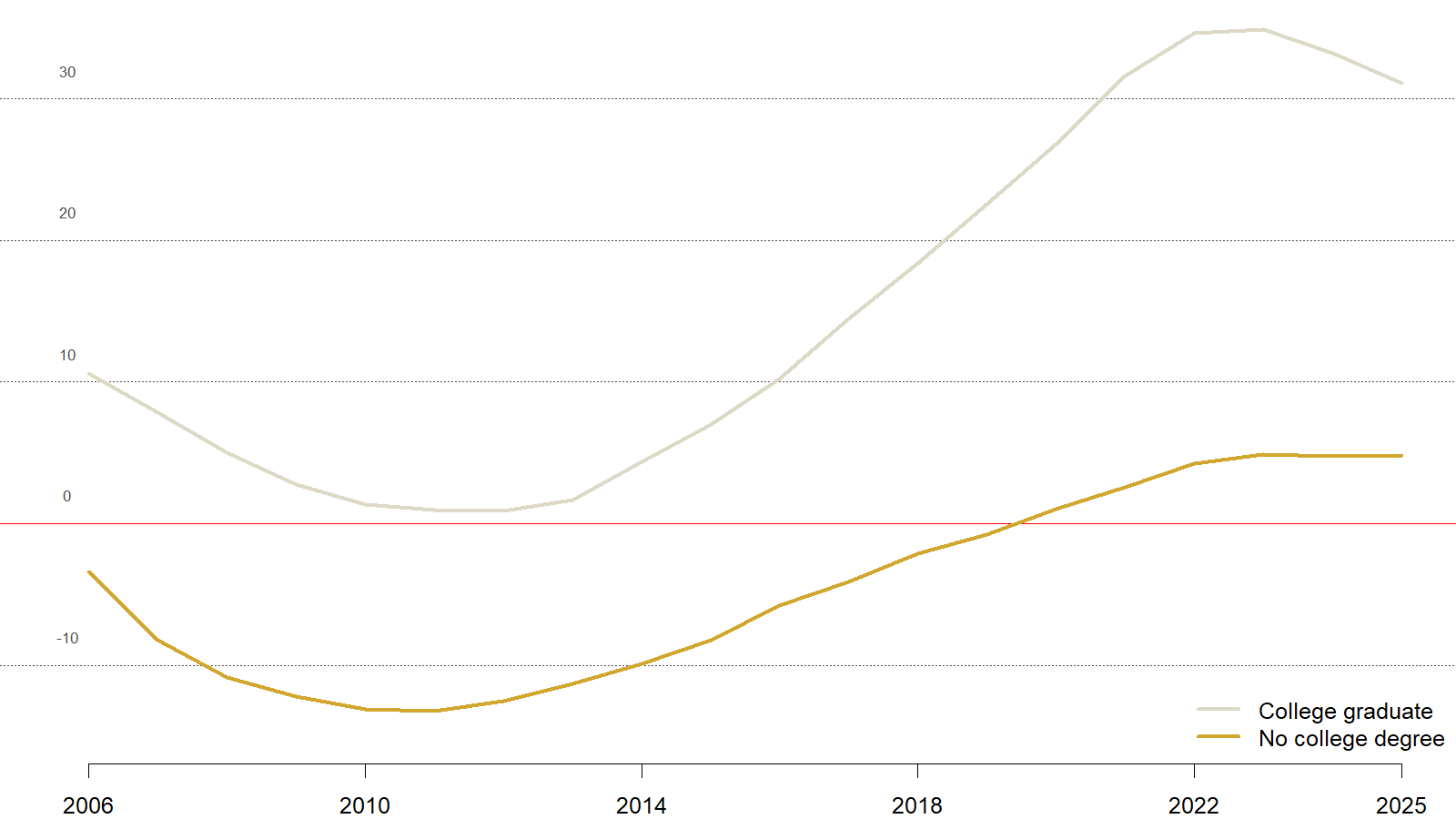
The diploma divide among White Coloradans widened substantially beginning in the mid-2010s. Even the most Republican leaning group – White Coloradans without a college degree – has been trending toward the Democratic Party, and by about 2020, they were divided evenly between the two parties. Today, they lean slightly Democratic overall.
White Coloradans with a college degree moved rapidly in the Democratic direction beginning in the 2010s. There is some indication that this group has leveled out or even turned somewhat away from the Democratic Party in the last few years, but there remains an extraordinarily large gap between White Coloradans with a college degree and those without in terms of their partisan balance.
Concluding thoughts
The Democrats' advantage in Colorado runs deep. At a time when the national party brand is struggling, most major demographic groupings in Colorado lean toward the party in a way that seems to be only increasing over time. It is especially striking that Democrats run slightly ahead of Republicans even among White Coloradans without a college degree (a group that in most other places in the country is solidly Republican and has been trending away from the Democratic Party for decades).
As I discussed in my look at the relationship between educational attainment and political outcomes at the aggregate level in a previous post, the individual-level relationship between educational attainment and partisanship while significant is not sufficiently large to explain the very high aggregate-level association between the proportion of college graduates in a state or a county and the association with election results.