The invisible primary in Colorado: Democratic governor


The first votes to decide the nominations in the 2026 gubernatorial election in Colorado won’t be cast for nearly five months, but the likely candidates have been busy for months already securing endorsements and campaign donations for their races for the governor’s mansion. This is sometimes called the “invisible primary.”
Reading the tea leaves of endorsements and patterns of campaign contributions is a bit of a dangerous game. In the lead up to the 2016 presidential election, the estimable Nate Cohn produced a very cogent analysis of all the major candidates for the Republican nomination. Unfortunately, the analysis didn't consider Trump's disruption of the field at all, and the rest, as they say, is history.
A note on the data used in this post
In this post, I’m focusing on monetary contributions from individuals. I’ve drawn data for this post from the TRACER database (for state-level offices) and Adam Bonica’s DIME database (for federal offices). There are several caveats that should be kept in mind about the analysis below. First, the datasets that get produced for campaign finance disclosure are difficult to massage into something worth analyzing. Secondly, a substantial share of campaign contributions from individuals are given in amounts that are under the disclosure threshold. At the federal level, this means we don’t know the identities of people who give less than $200 to a candidate. The state-level threshold in Colorado is much lower ($20).
The biggest problem facing anyone attempting the analysis that I am in this post is to consolidate the records across a range of sources into individual-level records rather than contribution-level records. The solutions to this problem are never completely failproof. Most contribution records include name, address and employer. This information can be used to try to identify all of the contributions from a single individual (a process called record linkage), but the process can produce both false positive linkages (thinking that two records are actually from the same individual) and – probably more commonly – false negatives (missing the fact that two records are actually from the same individual).
The 2026 Democratic candidates
The frontrunners for the Democratic nomination for governor in Colorado are Attorney General Philip Weiser and the senior senator from the state, Michael Bennet. Both these candidates have previously won – and are currently serving in – statewide office. Weiser was first elected in 2018 on the same ballot as Jared Polis during his successful run for Governor eight years ago, and Bennet was first elected in 2010. Bennet won his most recent election (to his third term in the senate) also in 2022. In the 2022 elections, Bennet and Weiser both received approximately the same share of the vote (56% and 55% respectively).
As of the January 2026 filing deadline. Weiser had raised significantly more campaign funds relative to Bennet. Weiser's campaign reported raising $4.57 million as of January 15, and Bennet's campaign raised $3.46. The vast majority of this money has come from individual donors. The TRACER database includes records of 41,428 contributions from individual donors to these two candidates (each candidate received about half of these donations). Based on my analysis of the files, these contributions come from 21,361 unique individuals.
Whither the Polis donor coalition?
Over Governor Polis's two terms in office, I estimate that he received contributions from 11,989 total donors (at least among the itemized donors who gave more than the disclosure threshold). Polis largely funded his own campaigns, and he relied on individual donors to a much lesser degree than either Weiser or Bennet have to date. Indeed, Polis's total contributions from individual donors over his entire eight years as governor totaled less than a million dollars (a little more than $831,000). So far in the 2026 campaign, both Bennet and Weiser have significantly shot past that total.
Polis's donors also gave in substantially smaller increments to his campaign compared to either Weiser or Bennet. The average donor to the Polis campaign gave less than $70 (again, in total over the entire eight years). Indeed, Polis imposed a voluntary cap of $100 per individual donor during his campaigns. Both Bennet and Weiser so far at this point in their campaigns have received substantially more per donor (the average donor to the Bennet campaign has contributed just under $300 while the average donor to the Weiser campaign has given somewhat more than $400).
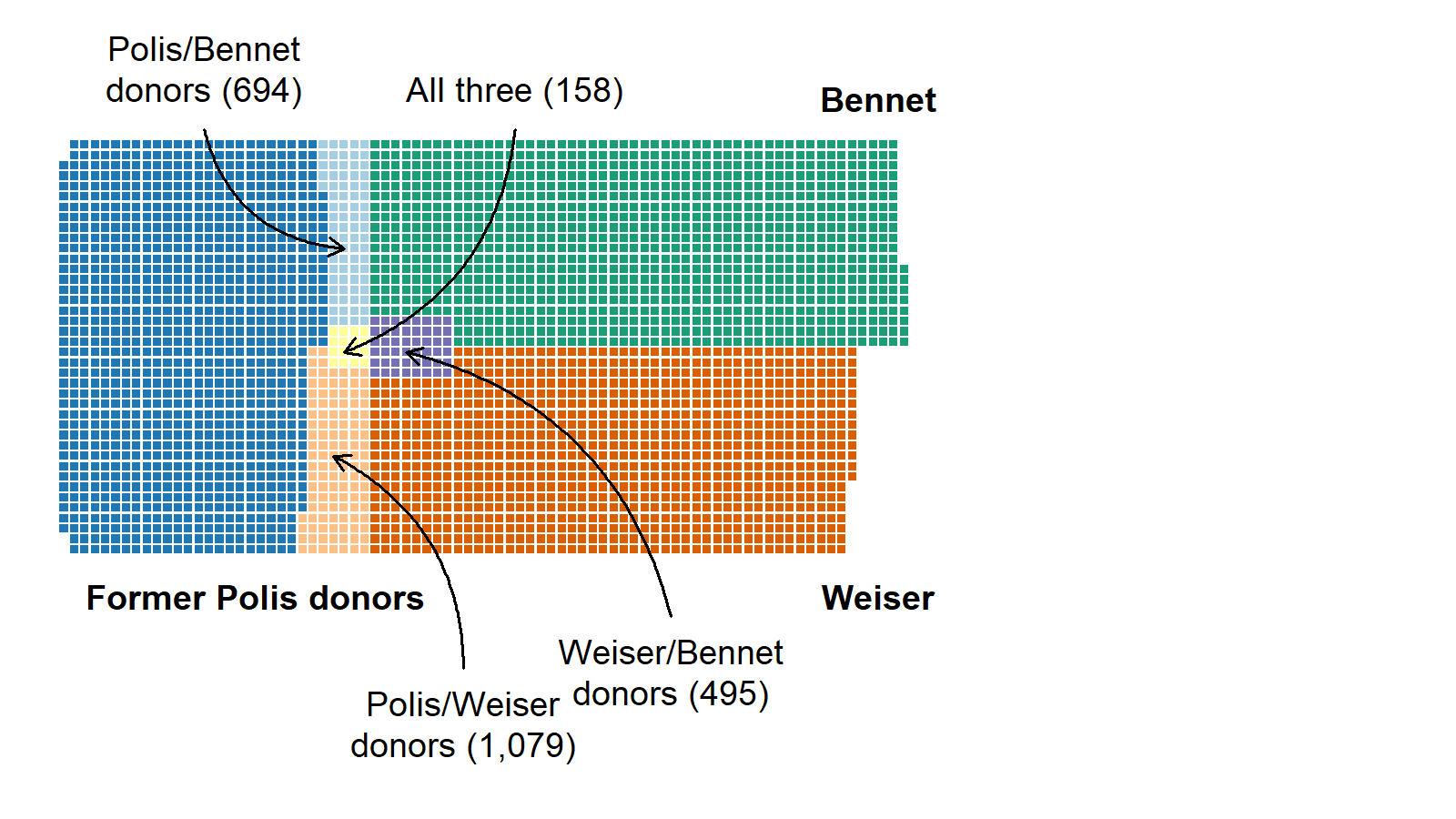
To this point, Weiser has attracted more past Polis donors to his campaign than Bennet. Overall, 12% of Weiser's donors donated to Polis in past cycles. Bennet's share of donors who had previously contributed to Polis is somewhat smaller (8%). A large share (83%) of Polis's donors have not (yet) given to either candidate.
The graphic below shows the overlap between these sets of donors. Each square in the graphic represents 10 donors. The darker blue portion on the left side of the graphic represents Polis donors who have not contributed to either Bennet or Weiser's 2026 gubernatorial campaigns. The darker green on the upper right hand portion of the graphic shows the donors who donated only to Bennet's campaign but not Weiser's or Polis's. The lighter blue shaded region represents the 694 individuals who had previously given to Governor Polis and also have donated to Bennet's campaign.
Overlap in the donor bases of Polis and the Democratic frontrunners
For better or worse, fundraising is a significant part of most politicians' jobs. Self-funded candidates are able to direct their energy and attention toward other activities without the need to spend so much time fundraising, and they often frame their go-it-alone strategy as a bulwark against the influence of outside funders. These candidates claim that since they are spending their own money, they cannot be "bought" (and imply that those that rely on outside funding will be indebted to their patrons).
The relatively shallow pool of donors that Polis has accumulated over his tenure in office reveals at least one weakness to the self-funding strategy. The lists of supporters that officeholders build up over time are some of their most valuable assets. One way that parties build a large base of support is by essentially recruiting people to be involved and invested in their campaigns. This is not to say that the fundraising/consultant complex is altogether healthy, but Polis has done his potential Democratic successors no favors on this front.
Absent an existing base of gubernatorial donors, each candidate has worked to build their own.
Retaining previous donors
Since both candidates have successfully run statewide campaigns, they both have extensive supporter lists to draw upon. A little more than 40% of donors to Weiser's gubernatorial campaign to date donated to his attorney general campaigns in the past. Bennet has a similar share of his donors who have given to his past campaigns for the senate (38%).
Donors to the Weiser Attorney General campaigns
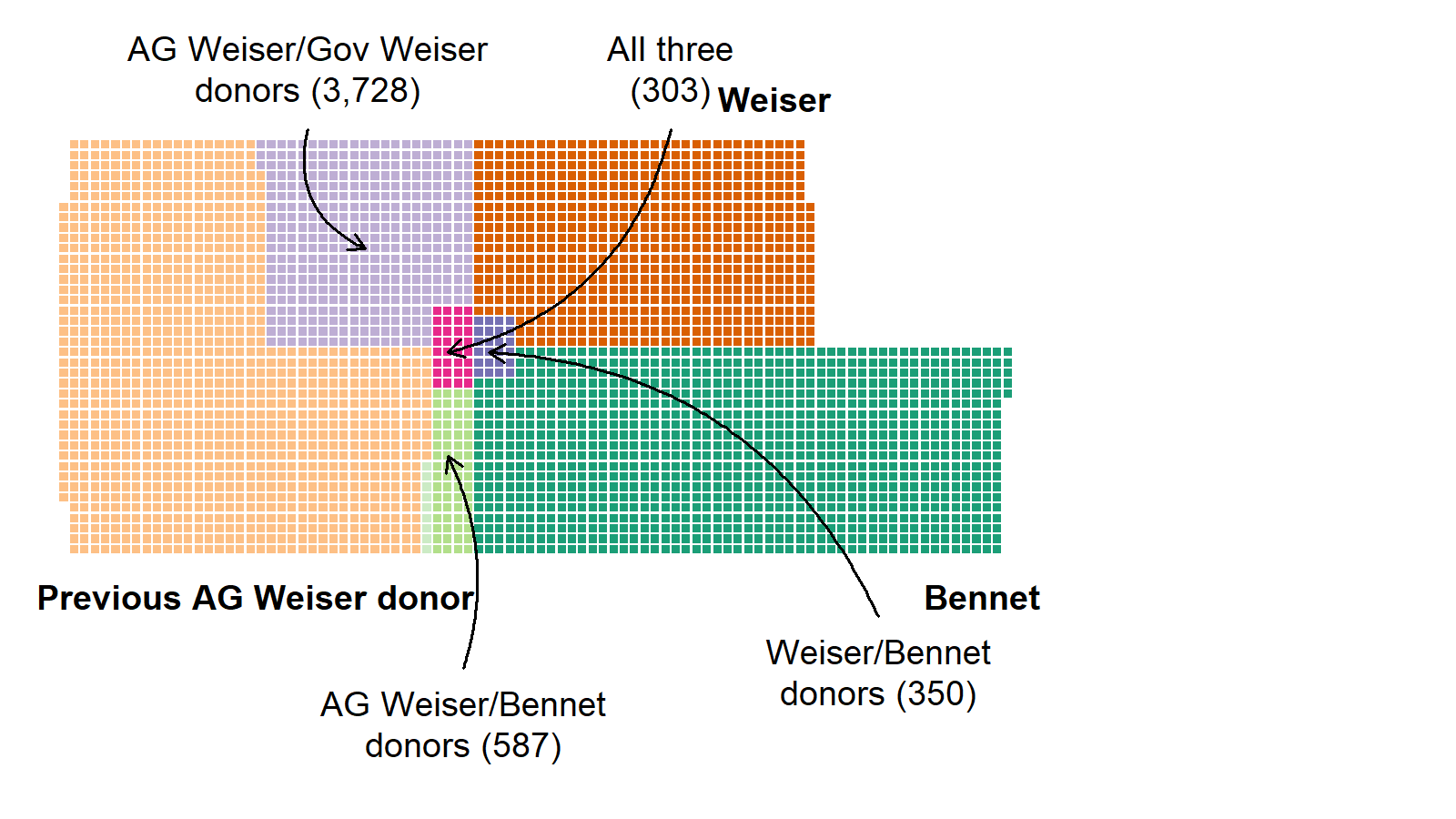
Over Philip Weiser's two successful candidacies for attorney general, he received donations from more than 15,000 unique individuals. Of these donors, just over a quarter have contributed to Weiser's campaign for governor. These former supporters make up just under 40% of the donors so far for his gubernatorial run (shown in lavender and fuchsia in the graphic below). Former Weiser AG donors make up only a very small fraction (8%) of Bennet's donors (shown in in light green and fuchsia).
Overlap between the donor bases of Weiser's attorney general campaign and the campaigns for the Democratic frontrunners
Donors to the Bennet senatorial campaigns
Compared to Weiser, Bennet has a much deeper network of former donors to draw from, although nearly 60% of the more than 80,000 individual donors to his senatorial campaigns since 2017 reported an address outside of Colorado.
The graphic below shows the overlap between the donors who gave to Bennet's senate campaigns since 2017 who reported they lived within Colorado. This includes about 30,000 individual donors. About a quarter of Bennet's gubernatorial donors come from the ranks of those who previously donated to his senate campaigns. Interestingly, Weiser is performing nearly as well as Bennet is with these former contributors to the Bennet senatorial campaigns.
Overlap between the donor bases of Bennet's senatorial campaign and the campaigns for the Democratic frontrunners
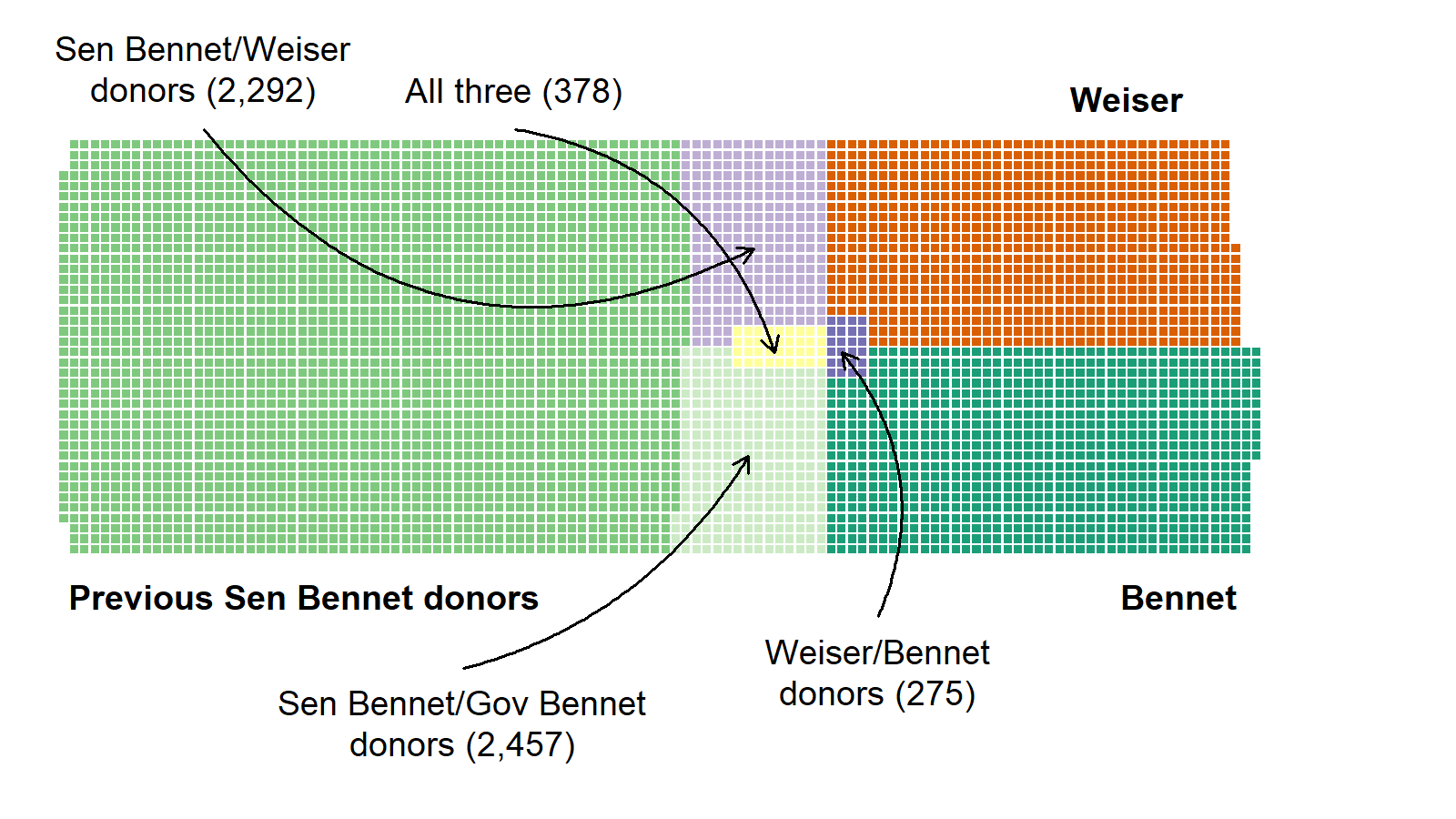
Bennet has a much clearer advantage among donors to his senate campaigns who live out of state. So far, 13% of his gubernatorial donors come from individuals who live outside of Colorado and have previously donated to his senate campaigns since 2017. Weiser has received contributions from just 163 of these donors.
Cross-party support
Neither candidate has received significant support from people who have given to Republicans in the past. Less than 5% of either Weiser's or Bennet's donors have previously given to Republican candidates.
Concluding thoughts
Campaign finance reports are one of the only quantitative indicators of candidate success prior to ballots being cast. As such, they receive a perhaps outsized share of attention in the political press. Candidates make explicit appeals to help them make strong showings for each disclosure deadline because they know it will earn them some positive press in the weeks heading up to their elections.
Beyond the dollar amounts raised, understanding how the coalitions of supporters for candidates past and present shift and move is just one additional data point. Campaigns – especially primary campaigns – are often governed by unpredictable factors. As noted earlier, Donald Trump's unexpected entry into the crowded Republican field in 2016 entirely upended that race in ways that most observers did not anticipate.
Another note of caution in reading the enigmatic movements of these early supporters of each candidate is that those who contribute money to candidates are significantly more tuned in to politics than the average voter. This goes doubly for those who contribute early to a primary campaign.
Moving forward in the Democratic gubernatorial primary, it will be interesting to see how successful each candidate is at activating their past supporters. As noted above, Bennet has a deeper pool of donors to draw from (even when we restrict it to just his Colorado donors). However, at least at this early stage, Weiser has done almost as well in securing support from Bennet's past donors as Bennet has been able to convert his senate supporters to supporters of his gubernatorial bid.