Racial and ethnic diversity in Colorado

In my last post, I looked at the ways in which politics in the United States has come to be oriented around education. This post will take a related approach to look at race and ethnicity within Colorado. Unlike the strong relationship between aggregate levels of education and votes for Democratic candidates, the relationship between the racial and ethnic composition of a place and voting is much more modest in Colorado.
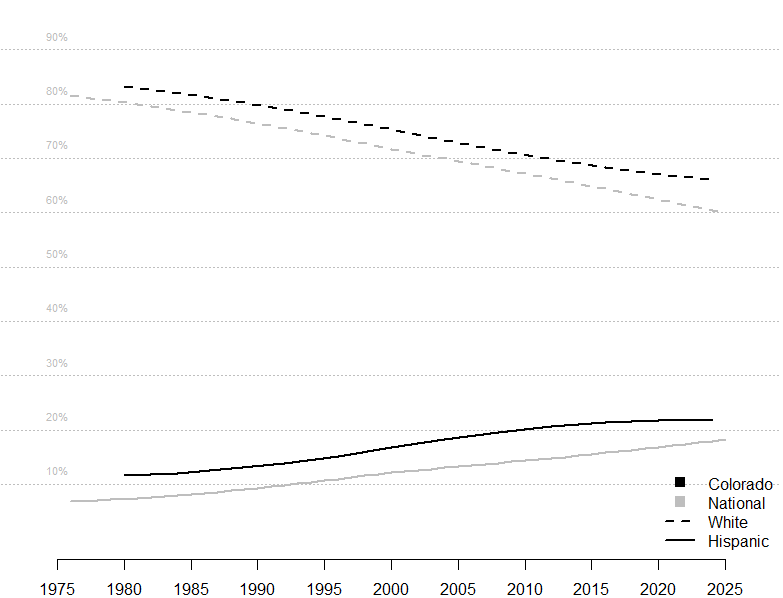
Colorado has consistently lagged behind the rest of the country in terms of racial diversity. In 1980, about 85 percent of Coloradans were non-Hispanic White compared with 80 percent of the nation more broadly. On the other hand, Colorado has, over the last 45 years or more, had a larger share of residents who are Hispanic compared to the rest of the country.
In parallel with the rest of the country, Colorado's population has become more diverse over this period. The share of non-Hispanic, White Coloradans has fallen about 20 percentage points over the past 40 years, while the share of Hispanic Coloradans has increased about 10 percentage points.
Share of Colorado residents who are ... (1976-2025)
Voting by race and ethnicity
At the individual level, race and ethnicity is one of the strongest demographic indicators of vote choice. Nationwide, 42% of non-Hispanic White voters supported Harris in 2024 compared to 55% of Hispanic voters 83% of Black voters.
In Colorado, the gap between White and Hispanic voters closed dramatically due to substantially higher support for Harris among White voters in Colorado. Black and Hispanic voters in Colorado look very similar to their national counterparts.
Voting for Harris among different racial and ethnic groups
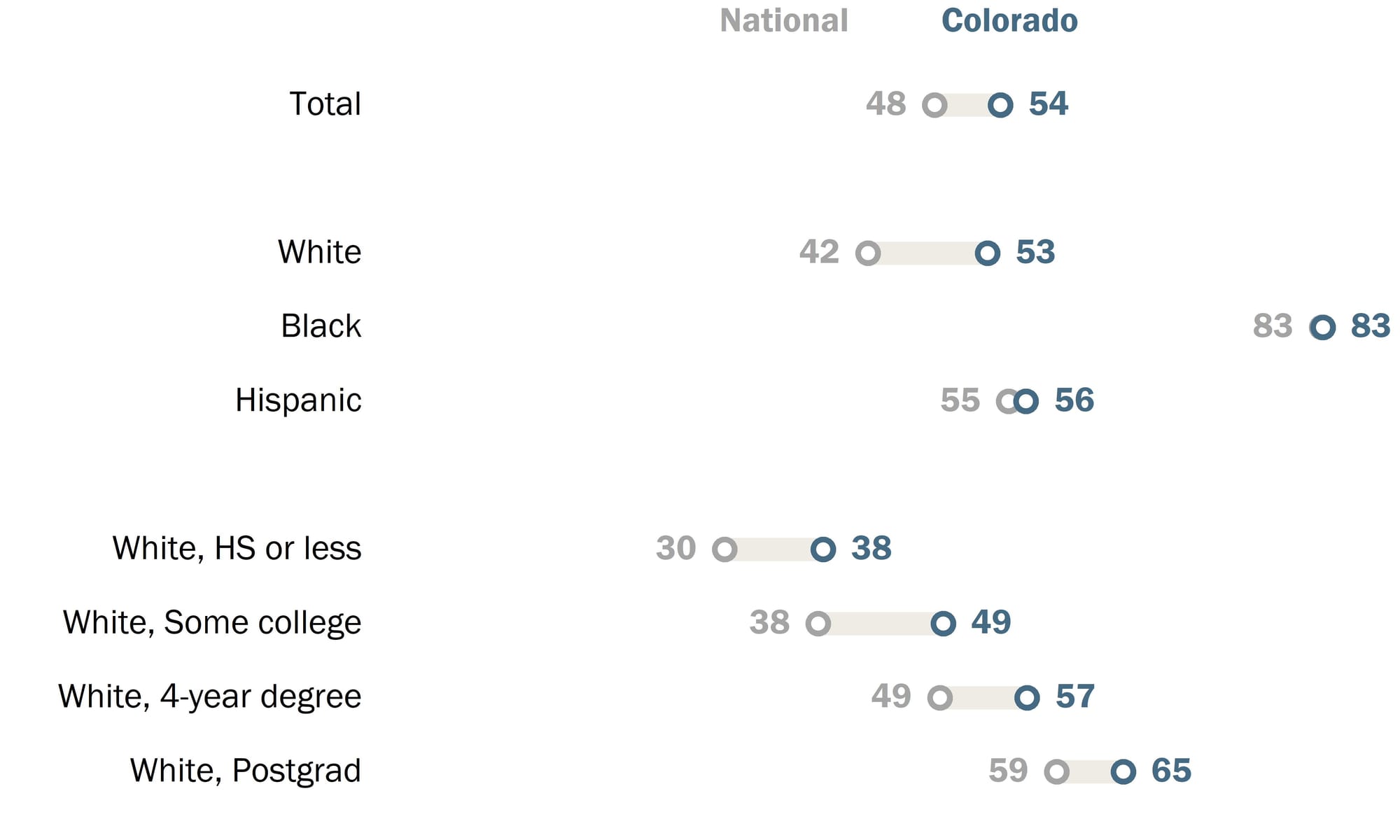
Among White voters, there are significant differences in Democratic voting by educational attainment. Only 30% of White voters with a high school degree or less voted for Harris nationally compared to 59% of White voters with a postgraduate degree. In Colorado, White voters across the range of education were substantially more Democratic in their voting behavior compared to their national counterparts.
State-level racial composition and political outcomes
At the state-level, racial and ethnic composition is only modestly related to political outcomes. Over the last 40 years, this relationship has strengthened, but compared to education, race and ethnicity are only loosely related to election outcomes.
In general, states that have a greater share of non-Hispanic White residents are less likely to vote for Democratic candidates.
Relationship between share of state's population that is White (non-Hispanic) and the Democratic share of the two-party vote, 1984
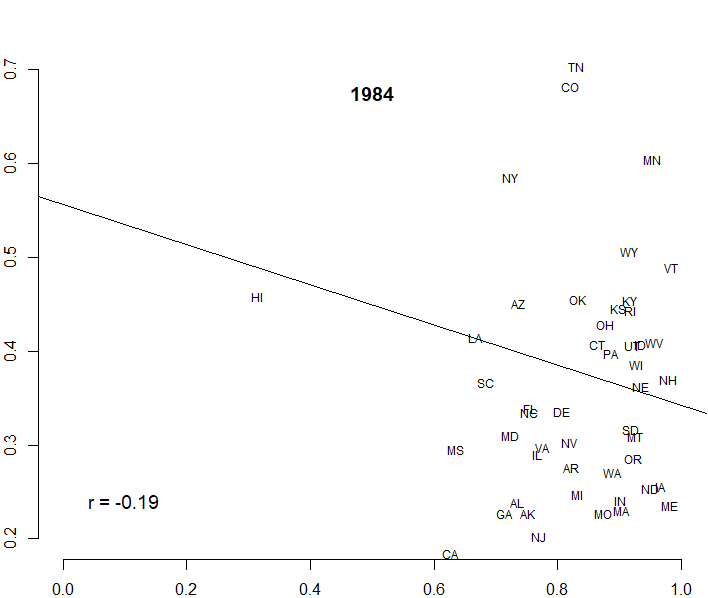
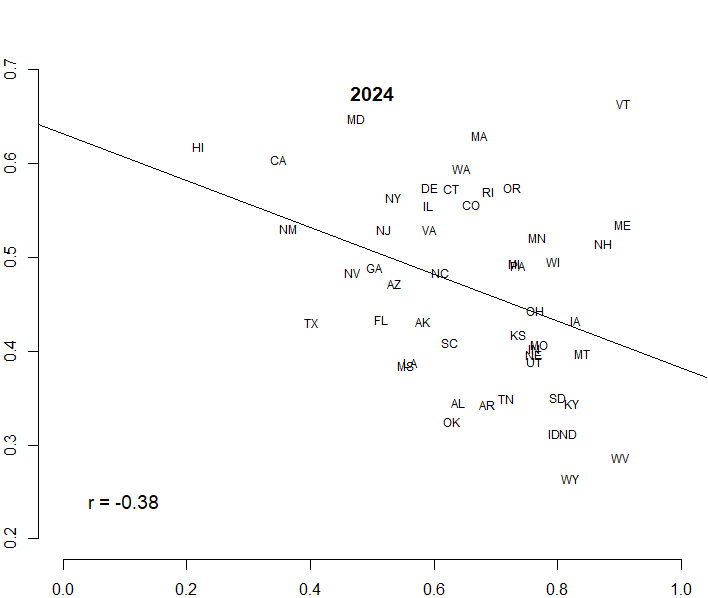
By 2024, the strength of the relationship between racial and ethnic composition and electoral outcomes (as measured by the correlation) had roughly doubled. Even so, the strength of the association between the racial and ethnic composition of a state in 2024 and election results is about half the magnitude of the association between the share of adults in a state with a college degree and election results that same year (as shown in my last post).
Relationship between share of state's population that is White (non-Hispanic) and the Democratic share of the two-party vote, 2024
County-level association between racial and ethnic composition and election outcomes
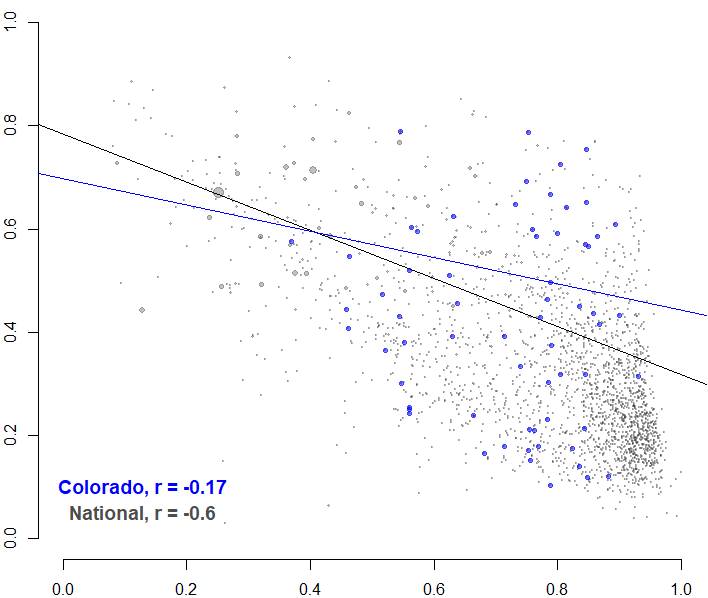
Looking at the country as a whole, the association between the share of a county's population that is White is substantially stronger than the state-level relationship above (r = -0.60 compared to r = -0.38).
When looking specifically at Colorado counties, the relationship between these factors is attenuated significantly.
Relationship between share of county's population that is White (non-Hispanic) and the Democratic share of the two-party vote, 2024
Precinct-level association between racial and ethnic composition and election outcomes
Looking at precinct-level election results in Colorado we see much the same relationship as was present in the county-level data in the relationship between precinct-level voting and the share of that precinct's residents who are White.
Only a handful of Colorado precincts have a substantial number of Black residents. We see a comparable (though oppositely signed) relationship between the share of a precinct's residents who are Black and 2024 election results.
Relationship between share of precinct's population that is ___ and the Democratic share of the two-party vote, 2024
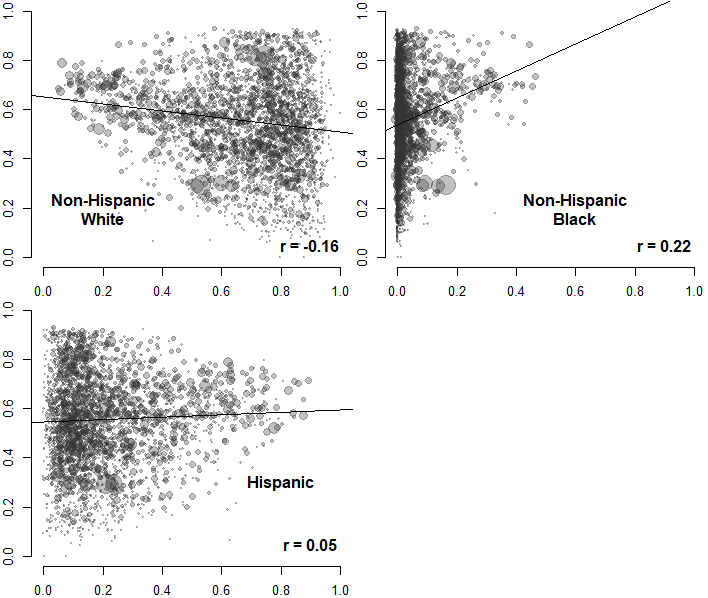
The relationship between political outcomes in a precinct and the share of that precinct's residents who are Hispanic was substantially smaller than was seen for either White or Black residents in Colorado.
Race and politics in Colorado
At the national level, it is impossible to understand politics without understanding how it intersects with race. Colorado politics, on the other hand, does not evince the same types of racial divisions as are present in other parts of the country. This is emphatically not to say that Colorado is some kind of post-racial utopia where all join hands and sing kumbaya (see this, this, this, this, this, this and this for just a handful of examples of Colorado's failures when it comes to racial justice), but perhaps due to its relatively more homogenous population, Colorado's contemporary politics do not revolve around racial lines.
Reflecting again on the last analysis I posted on the relationship between education and presidential voting in Colorado, it is instructive to highlight the similarities and differences. In both the case of education and racial and ethnic composition, the trends in Colorado parallel national trends. In each case, the relationship between both factors at the state-level have strengthened over time. However when it comes to education, the variation among counties in Colorado very closely mirrored the national trend. This does not seem to be true of race and ethnicity within Colorado which has a substantially weaker association than we see nationally.
The analysis here also shows how race and education interact. Especially among White voters, more education is associated with greater likelihood of supporting Democratic candidates. Within Colorado, White voters of all education levels are about 8 percentage points more likely than White voters of similar education levels to support Democratic candidates.




.jpg)