Donor networks in Colorado


In the last pair of posts, I’ve looked at the donor coalitions of the Democratic and Republican candidates for the 2026 gubernatorial race in Colorado. Of course, there are more races in 2026 than just the contest at the top of the ballot. In this post, I'll look at some of the other major candidates for office in Colorado in 2026.
A note about the data used in this post
The data from this post is drawn from databases of donors to candidates for state office in Colorado as well as donors to candidates running for federal office in Colorado. The data comes from disclosed contributions over the past 10 years to these candidates. These hundreds of thousands of records of individual donations were processed by a record linkage algorithm to extract individual donors. Ultimately, I identified 931,203 contributions that were made by 267,674 individuals to 1,110 candidates running for office. After identifying these individual donors, I also matched donors to these candidates who gave to Trump, Harris, the Republican National Committee or the Democratic National Committee (for more on how the record linkage was conducted, see the first post in this series).
Donor base similarity as a measure of candidate closeness
This database of donors can be used to construct measures of the closeness between different candidates running for office. The measure is constructed by calculating the cosine similarity between two candidates' sets of donors. Cosine similarity is useful in this context as it can be used to compare two candidates who have very different numbers of donors. Without getting into the matrix math of it all, it is essentially a measure of the overlap between the donor coalitions of two given candidates. It is calculated for pairs of candidates, and the measure ranges between zero (no overlap between the two donor groups) and one (the two candidates have the exact same donors).
The Democrats
Democrats' fortunes are rising in Colorado, and 2026 is looking to be a very good year for the DNC nationally. Colorado didn't see the same Republican swing in 2024 as much of the rest of the country, but even with a higher floor, almost all political observers predict a strong showing for Democrats in November.
The graphic below shows an abstract representation of the "closeness" of major Democratic candidates in Colorado (with the DNC and Harris for reference) as measured by their donor coalitions. One way to think about this graphic is as if each node were connected by a series of springs that are trying to pull them together based on their similarity (and push dissimilar nodes apart). The graphic is drawn to minimize the tension in these hypothetical springs.
It should be kept in mind what this graphic is not saying. The connections between candidates here are drawn based on the similarity of the people who gave to them. Many candidates also control political committees that give to other candidates. Those kinds of connections between candidates are not shown in this graphic. When the graphic below places Trisha Calvarese nearer to Harris and the DNC than her primary opponent Eileen Laubacher, it is because Calvarese's donor base has more overlap with donors to Harris and the DNC than does Laubacher's donor base. It is also important to note that the absolute placement of candidates in the graphic is not meaningful. The important thing is how they are placed relative to one another.
Network structure of Colorado Democratic candidates by donor base similarity
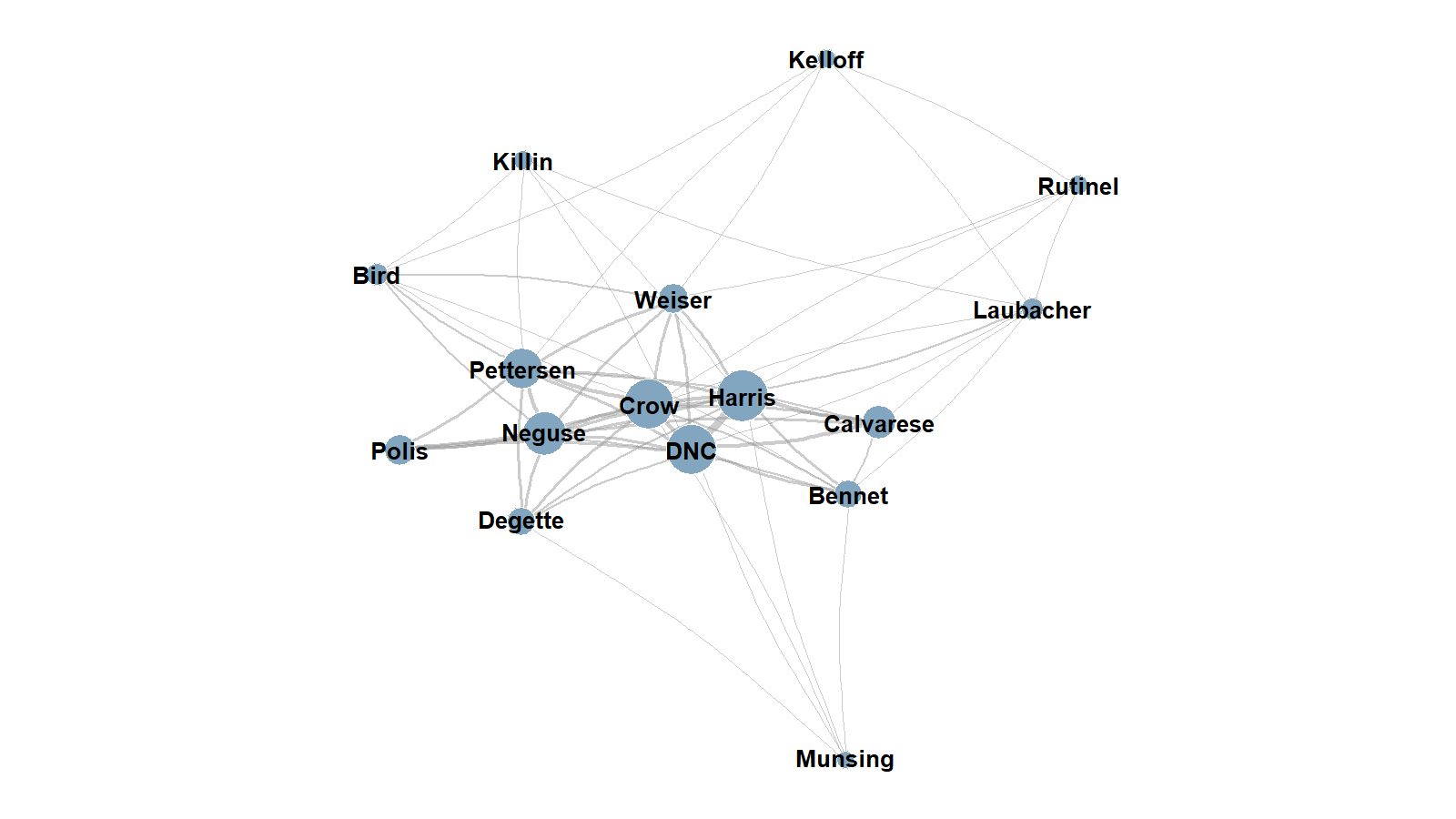
There are several interesting elements of the above graphic. Firstly, we see a tight central core of incumbent congressional Democrats (Crow, Neguse and Pettersen). Interestingly, Calvarese is more central to the Democratic network than either Degette or the two frontrunners for the Democratic nomination for governor. Calvarese is running in the fourth district, and she is facing the more distal (at least in terms of donor coalitions as of the last reporting deadline) Eileen Laubacher. This race is generally seen as a longshot for Democrats, but given the swings we have seen in other districts across the country in elections that have been held since November 2024, it is perhaps not totally out of contention.
On the perimeter of the graphic, we see several of the leading candidates in primaries that will decide who will face Colorado's incumbent Republican representatives: Kelloff (CO-3), Laubacher and Calvarese (CO-4), Killin (CO-5) and Bird, Munsing and Rutinel in the most closely divided district in the state (CO-8). Jared Polis also falls along the perimeter of the graphic (in the post on the race for the Democratic nomination for governor, we saw how Polis's self-funding meant he never had to build a large donor base to support his campaigns.
Network structure of Colorado Republican candidates by donor base similarity
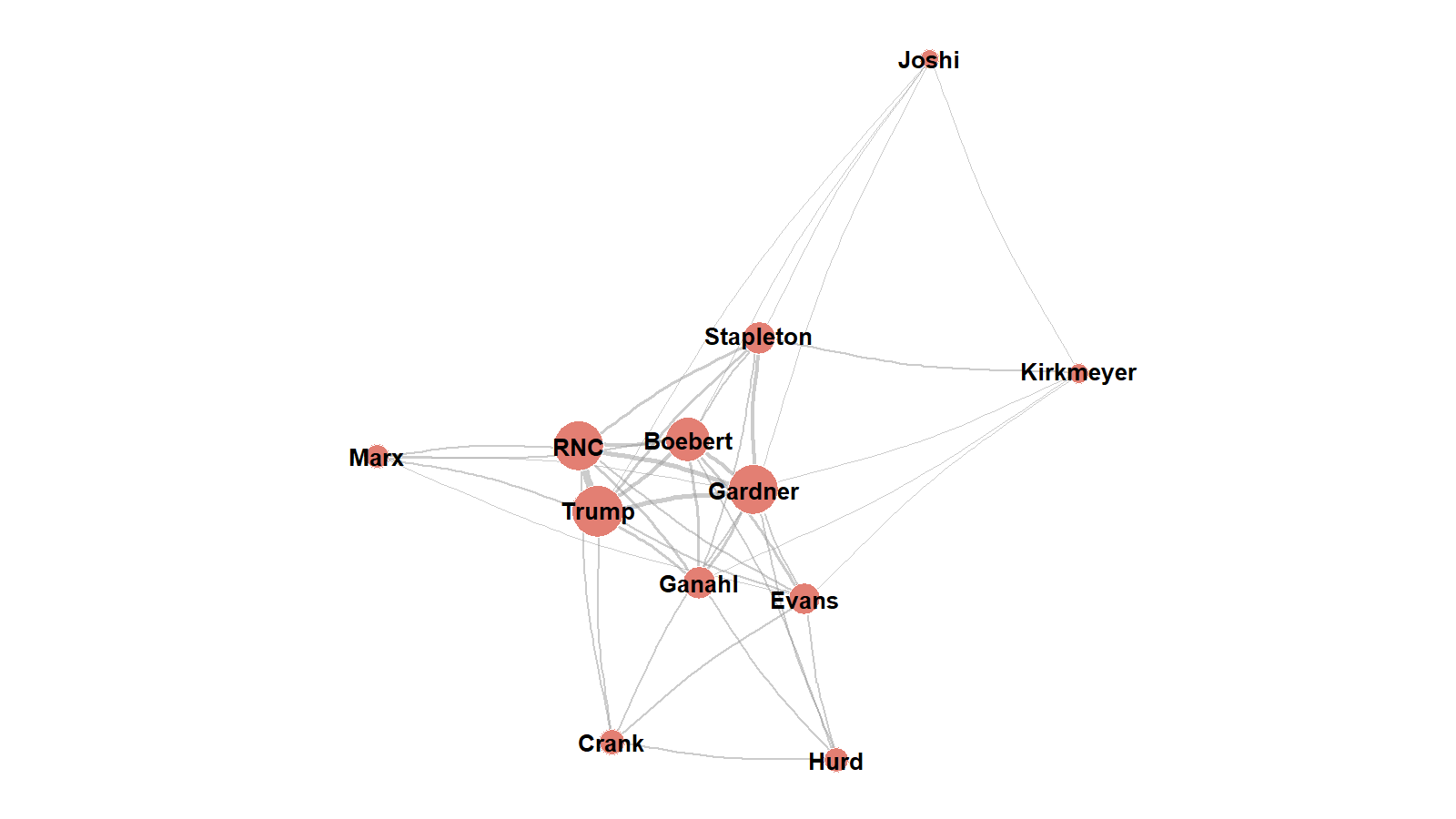
Republicans have fewer serious candidates in 2026, reflecting their weaker position in the state. Evans, the embattled incumbent in the eighth district, is likely looking at the end of his congressional career. Even so, he is among the most central of the Republican incumbents in Colorado. In contrast to the Democratic network, the Republican incumbents occupy a substantially more peripheral space in the plot.
Lauren Boebert is the most central node in the network among the current office holders on the Republican side. As election day nears, it will be interesting to see how the shape of this graph evolves.
Concluding thoughts
Campaign contribution data gives us one perspective on the state of the early 2026 campaign. Modern political campaigns require a great deal of resources, and the concreteness of the numbers in disclosure filings is catnip for political journalists and pundits because they give us something easily quantifiable to talk about prior to the elections. Candidates know this as well, and they often make explicit appeals in their fundraising efforts to make a good showing when the numbers are released.
While fundraising totals are important, they are far from determinative. In the recent special election in Texas that received so much attention in the national (and even global) press, the Democratic upset victor had been outspent seven-to-one. Ultimately, it is voters – not dollars – that win elections.